

June 3, 2026
Commercial Construction Project Requirements: A Pro Guide

Commercial construction project requirements are the comprehensive set of regulatory, contractual, and procedural standards governing every phase of a commercial build, from programming and design through permitting, construction, and closeout. These requirements exist because commercial buildings carry occupancy loads, fire risk profiles, and structural complexity that residential codes simply do not address. Frameworks like the International Building Code (IBC), the Americans with Disabilities Act (ADA), NFPA 101, and IECC energy standards form the backbone of compliance for any project manager operating in this space. Understanding where these standards intersect, and where local jurisdictions add their own layer, is the difference between a project that closes out cleanly and one that stalls at final inspection.
What are commercial construction project requirements?
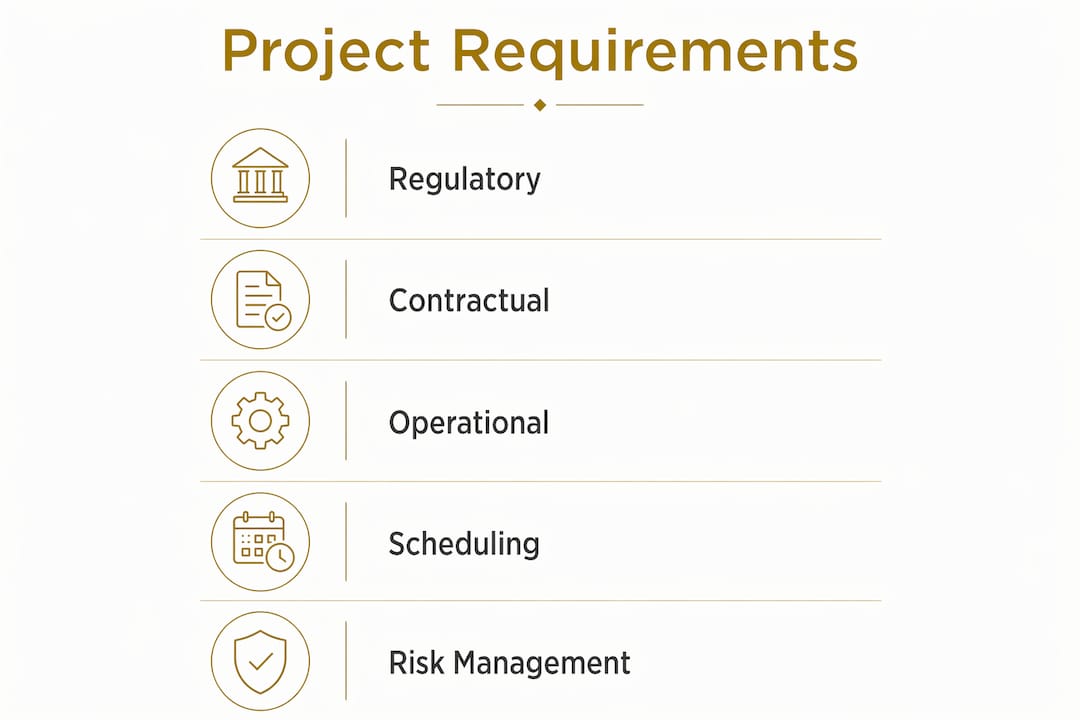
Commercial construction project requirements are defined by three interlocking categories: regulatory compliance, contractual obligations, and operational procedures. Each category carries its own documentation trail, its own stakeholders, and its own consequences when mismanaged. A project manager who treats these as separate checklists, rather than an integrated system, will encounter conflicts between design intent, permit conditions, and contract scope before the first foundation pour.
The regulatory layer is the most publicly visible. Commercial building codes in the U.S. are governed at the state and local level, based on model codes like the IBC with local amendments. This means there is no single national building code. A mixed-use development in Los Angeles operates under California Title 24 amendments to the IBC, while the same building type in Miami follows Florida Building Code modifications. Project managers must verify the adopted code cycle and any local amendments before design development begins, not after permit submission.

The contractual layer defines who is responsible for what, under what conditions, and at what cost. The operational layer covers submittals, requests for information (RFIs), inspections, commissioning, and closeout documentation. All three layers must be established, tracked, and enforced simultaneously throughout the project lifecycle.
Key regulatory frameworks governing commercial builds
The IBC classification framework organizes commercial buildings by occupancy type (A through U), construction type (I through V), height, and allowable floor area. This classification directly determines which structural systems, fire protection measures, egress configurations, and accessibility features apply. A Type I-A high-rise office building carries entirely different requirements than a Type V-B retail shell, even if both fall under the same local jurisdiction.
Beyond the IBC, project managers must coordinate compliance across several parallel frameworks:
- IECC (International Energy Conservation Code): Sets minimum envelope, mechanical, and lighting efficiency standards. California’s Title 24 Part 6 and Florida’s FEBC Chapter 13 represent two of the most demanding state-level energy code amendments in the country.
- ADA and Section 504: Federal accessibility mandates apply to all commercial buildings receiving federal funding or serving the public. Accessible routes, restroom configurations, parking ratios, and signage all require design-phase verification, not field correction.
- NFPA 101 (Life Safety Code): Governs means of egress, occupant load calculations, exit signage, and emergency lighting. Many jurisdictions adopt NFPA 101 alongside or in place of IBC Chapter 10.
- NFPA 13: The standard for the installation of sprinkler systems, referenced by virtually every jurisdiction for commercial occupancies above a defined area or height threshold.
- Fire door regulations: Fire-rated door assemblies, hardware, and labeling requirements are enforced at the local authority level and are frequently cited during final inspection.
Local building departments retain authority over permit issuance, plan review timelines, inspection scheduling, and certificate of occupancy. A project that is fully IBC-compliant on paper can still face delays if the local jurisdiction has adopted a different code cycle or added amendments that were not caught during design review.
| Code/Standard | Scope | Governing Body |
|---|---|---|
| IBC | Structural, occupancy, egress | ICC (adopted by states/localities) |
| IECC | Energy efficiency | ICC (state amendments common) |
| ADA | Accessibility | U.S. Department of Justice |
| NFPA 101 | Life safety, egress | NFPA (locally adopted) |
| NFPA 13 | Fire suppression systems | NFPA (locally adopted) |
What documents and contracts does a commercial project require?
The Owner’s Project Requirements (OPR) document is the single most important piece of pre-construction documentation on any commercial build. The OPR defines functional, operational, and financial outcomes and serves as the project’s guiding reference throughout design, construction, and commissioning. Without a detailed OPR, scope disputes between owner, architect, and contractor become almost inevitable, because each party fills the gaps in their own favor.
The Basis of Design (BOD) document translates the OPR into specific technical systems and design decisions. Together, the OPR and BOD form the contractual baseline against which submittals, RFIs, and change orders are evaluated. Construction drawings, specifications (CSI MasterFormat divisions), and geotechnical reports complete the core document set required before permit submission.
Project delivery method determines how these documents flow between parties and who carries design risk:
- Design-Bid-Build (DBB): Owner contracts separately with architect and general contractor. Design is complete before bidding. Owner retains design risk.
- Design-Build (DB): Single entity holds both design and construction contracts. Faster delivery, but owner must define requirements precisely upfront.
- Construction Manager at Risk (CMAR): GC is engaged during design, provides a Guaranteed Maximum Price (GMP), and manages subcontractors. Balances early contractor input with owner control.
- Integrated Project Delivery (IPD): Multi-party agreement aligns owner, architect, and contractor incentives. Best suited for complex, high-value projects.
Design-build with GMP contracts reduces project schedules by 15 to 25% for projects in the $1M to $30M range. That schedule compression is real, but it requires the owner to invest more effort in defining requirements before design begins, not less.
Pro Tip: Require all subcontractors to carry General Liability minimums of $1M per occurrence and $2M aggregate, and verify that builder’s risk, professional liability, auto, and umbrella policies are in place before any work begins. For projects over $1M, surety bonds are standard and protect the owner against contractor default.
How should you plan schedules and budgets for compliance?
Schedule and budget planning for commercial projects require the same discipline as the regulatory compliance work. The two are inseparable. A permit delay caused by a missed code requirement can cascade into a long-lead equipment conflict that pushes the project six months past the original completion date.
Long-lead procurement items like elevators, switchgear, and custom HVAC equipment carry lead times of 12 to 60 or more weeks. These items must be identified during schematic design and integrated directly into the master schedule before the GC is even under contract. Waiting until construction documents are complete to order switchgear is one of the most common and most avoidable causes of commercial project delays.
Critical Path Method (CPM) scheduling is the standard tool for managing commercial project timelines. CPM identifies the sequence of tasks that directly controls the project completion date, allowing the project manager to focus resources and attention where schedule risk is highest. Software platforms like Primavera P6 and Procore both support CPM scheduling with real-time update capabilities.
Budget structure for commercial projects distinguishes between hard costs (direct construction, equipment, and materials) and soft costs (design fees, permits, insurance, financing, and testing). Contingency allowances typically range from 5% to 15% of base construction cost, depending on design complexity and project risk. A ground-up Class A office building warrants a 10 to 15% contingency; a tenant improvement in an existing shell may justify 5 to 8%.
Pro Tip: Establish a formal change order log from day one and require written authorization before any out-of-scope work begins. Change orders and scope creep are the largest sources of cost overruns on commercial projects, and a disciplined log reduces disputes at closeout.
How does risk management protect a commercial project?
Risk management in commercial construction is not a single event at project kickoff. It is a continuous process of identification, documentation, allocation, and mitigation that runs parallel to every other project activity. Physical risks (site conditions, weather, material failures), financial risks (cost overruns, contractor insolvency), regulatory risks (code changes, permit denials), and relational risks (subcontractor disputes, design errors) each require a specific response strategy.
The foundational principle of risk allocation is that each risk should be assigned to the party best positioned to control it. A GMP contract allocates cost overrun risk to the contractor. A cost-plus contract shifts that risk back to the owner. Neither structure is universally superior. The right choice depends on how well the scope is defined at the time of contracting.
OSHA standards, particularly 29 CFR 1926 (Construction Industry), govern site safety on all commercial projects. Experience Modification Rate (EMR) tracking measures a contractor’s safety performance relative to industry averages. An EMR below 1.0 signals a better-than-average safety record. Many owners and public agencies require EMR documentation as a prequalification criterion.
“The commissioning process is not a final checkbox. It is the verification that every system the owner paid for actually performs as specified under real operating conditions.”
Commissioning on complex buildings requires 2 to 4 months of inspections, functional performance tests, and documentation review before a certificate of occupancy is issued. Skipping or compressing commissioning to recover schedule is a false economy. Systems that fail post-occupancy cost far more to remediate than they would have cost to commission correctly.
Submittals and RFIs serve as the quality control mechanism during construction. Submittals verify that proposed materials and equipment meet specification requirements before installation. RFIs resolve design ambiguities before they become field conflicts. A well-managed submittal log, tracked in platforms like Procore or Autodesk Construction Cloud, reduces rework and supports the as-built documentation required at closeout.
Key takeaways
Successful commercial construction project management requires integrating regulatory compliance, contract structure, procurement planning, and risk controls from the earliest stages of project development.
| Point | Details |
|---|---|
| Regulatory compliance starts at classification | IBC occupancy and construction type classification determines every applicable code and standard for the project. |
| OPR is the project’s foundation | A detailed Owner’s Project Requirements document prevents scope disputes and aligns all parties on measurable outcomes. |
| Procurement drives the schedule | Long-lead items like switchgear and elevators must be ordered during design to prevent cascading delays. |
| Contingency must match complexity | Budget contingencies range from 5% to 15% based on project risk; under-budgeting this line item is a leading cause of overruns. |
| Commissioning is non-negotiable | A 2 to 4 month commissioning process validates system performance and is required for certificate of occupancy on complex builds. |
What I’ve learned managing complex commercial requirements
After working through projects that range from ground-up commercial shells to high-complexity mixed-use builds in Los Angeles, the pattern that separates successful projects from troubled ones is almost always the same. The teams that invest in a thorough OPR before design begins spend far less time arguing about scope during construction. The teams that skip it spend that time, and more, in change order negotiations.
The second lesson is about procurement. Every project manager knows that long-lead items matter. Fewer actually integrate procurement milestones into the master schedule at the programming phase. When a switchgear delivery slips by eight weeks because it was ordered three months late, the entire MEP rough-in sequence shifts, and the project never fully recovers. The fix is not faster ordering. It is earlier ordering, which requires earlier decision-making from the owner on system specifications.
Change management discipline is the third area where I see the most variance. The formal change order log is not bureaucracy. It is the document that protects every party at closeout. Projects that maintain a clean, current log close out faster, with fewer disputes, and with better relationships between owner and contractor. That outcome is worth the administrative effort many times over.
The safety management approach a firm brings to a project also signals how it manages everything else. A contractor with a strong EMR and a documented safety program tends to run tighter schedules, better submittals, and cleaner punch lists. Safety culture and project management culture are the same culture.
— Daniel
How Builtblackbriar supports your commercial construction goals

Builtblackbriar brings the same discipline that governs complex luxury builds in Los Angeles to every commercial project it manages. From OPR development and permit coordination through procurement scheduling and commissioning oversight, the team applies a technology-integrated process that keeps owners informed and projects on track. Builtblackbriar’s experience with technically demanding builds, including subterranean structures and large-scale custom installations, translates directly into the kind of risk awareness and schedule control that commercial projects demand. Explore Builtblackbriar’s project management services or review the firm’s construction expertise to understand how this approach applies to your next project.
FAQ
What are the main commercial construction project requirements?
Commercial construction project requirements include regulatory compliance with codes like the IBC, ADA, NFPA 101, and IECC, plus contractual documentation (OPR, BOD, construction drawings), insurance and bonding standards, and operational procedures covering submittals, inspections, and commissioning.
Which building code governs commercial construction in the U.S.?
There is no single national building code. Commercial building regulations in the U.S. are adopted at the state and local level, based on model codes like the IBC, with jurisdiction-specific amendments that vary by state and municipality.
What insurance is required for commercial construction projects?
Standard commercial construction insurance requirements include builder’s risk, general liability (minimum $1M per occurrence and $2M aggregate for subcontractors), professional liability, auto, and umbrella policies, plus surety bonds for projects exceeding $1M.
How much contingency should a commercial construction budget include?
Contingency allowances for commercial projects typically range from 5% to 15% of base construction cost. Lower-complexity tenant improvements may require 5 to 8%, while ground-up or technically complex builds warrant 10 to 15%.
What is the Owner’s Project Requirements document?
The Owner’s Project Requirements (OPR) is a pre-construction document that defines the functional, operational, and financial outcomes the project must achieve. It serves as the reference standard for all design decisions, change order evaluations, and commissioning verification throughout the project lifecycle.