

May 27, 2026
Custom Home Specifications Explained for Homeowners

Building a custom home is one of the most consequential decisions you will make as a homeowner or real estate investor. Yet most people entering the process don’t realize that custom home specifications explained properly go far beyond choosing cabinet finishes or countertop colors. In practice, construction documents (the recognized industry term for detailed specifications) are legal, technical, and financial commitments that determine your project’s cost, timeline, code compliance, and long-term performance. Misunderstand them early and you pay for it late. This guide will change how you see every decision from lot survey to final inspection.
Table of Contents
- Key Takeaways
- Custom home specifications explained: what they really are
- Critical decisions to make before drawings begin
- Understanding energy code requirements in your specifications
- From specifications to move-in: how the timeline works
- My perspective on decision fatigue and what builders won’t always tell you
- Build your custom home with Builtblackbriar
- FAQ
Key Takeaways
| Point | Details |
|---|---|
| Specs are binding documents | Construction documents govern materials, finishes, and methods, not just aesthetics. They have legal and financial weight. |
| Early decisions prevent rework | Finalizing budget, site data, and major selections before drawings start protects your schedule and cost. |
| Energy codes shape your specs | IRC 2024 compliance paths directly influence insulation, air barrier, and mechanical system specifications. |
| Timeline is 12 to 18 months | Design, permitting, and construction follow defined phases; late specification changes at any phase add time and cost. |
| Quality follows specification detail | Build quality depends on specification rigor, not simply on whether a home is custom versus spec. |
Custom home specifications explained: what they really are
The term “custom home specifications” gets used loosely. It sounds like it means picking your preferred fixtures. What it actually means is something far more precise: a complete written and drawn description of every material, system, method, and standard that will go into your home. Architects and builders refer to these as construction documents, and they form the contractual backbone of your entire project.
A well-written specification package covers four broad categories:
- Structural specifications: Foundation type, framing lumber grade, beam sizing, load calculations, and seismic or wind uplift requirements specific to your site.
- Mechanical, electrical, and plumbing (MEP) specifications: HVAC system type and sizing, electrical panel capacity, outlet and fixture locations, and plumbing pipe materials.
- Cosmetic and finish specifications: Flooring types and grades, tile selections and installation methods, cabinetry construction, paint sheens, and hardware.
- Energy and envelope specifications: Insulation type and R-values, window U-factors and SHGC ratings, air barrier requirements, and ventilation strategy.
These categories are not independent. Choosing a radiant floor heating system, for example, affects your slab specification, your MEP layout, your thermostat placement, and your energy compliance path. One cosmetic preference can ripple through three other categories.
Pro Tip: Ask your builder or architect for a specification matrix that cross-references decisions by category. It forces conversations that prevent gaps and makes pricing transparent from day one.
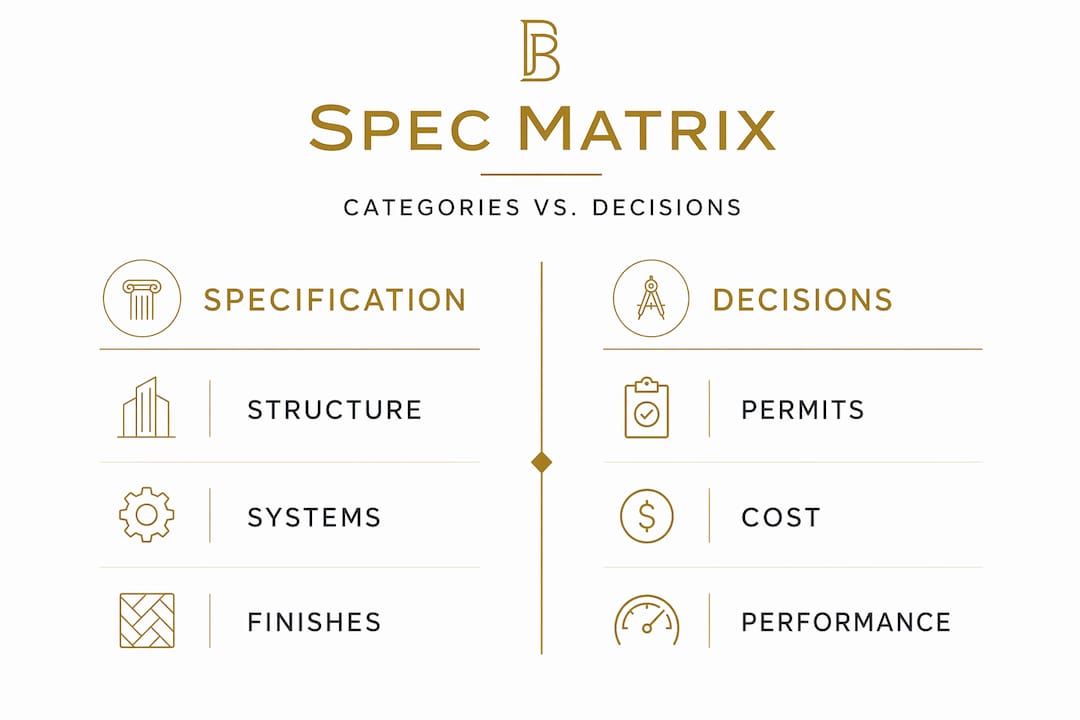
Here is a simplified comparison of how specification categories interact with project outcomes:
| Specification category | Affects permit drawings | Affects construction cost | Affects energy performance |
|---|---|---|---|
| Structural | Yes | High | Low |
| MEP systems | Yes | High | High |
| Finish and cosmetic | No | Moderate | Low |
| Envelope and energy | Yes | Moderate | Very High |
The detailed build specifications your team produces are what separate a home that performs over 30 years from one that looks great on move-in day and underperforms every year after. Working with experienced Newhall luxury builders means those documents are produced with the kind of precision that protects your investment.
Critical decisions to make before drawings begin
Most homeowners arrive at their first design meeting excited about aesthetics. Experienced builders will tell you that the real work happens in the two to three months before a single line gets drawn on paper. Pre-construction planning is where costly errors are either avoided or planted.
Here are the decisions that must be resolved before your architect begins architectural drawings:
- Hard budget with contingency set. Your total budget determines structural scope, finish grade, and square footage. Builders recommend a contingency fund of 10 to 20 percent of total construction cost to cover late-stage changes or unforeseen conditions. Treat that ceiling as immovable.
- Completed site survey and soils report. Your topography and soil bearing capacity directly dictate foundation type. A sloped lot in Los Angeles may require a deep caisson foundation or a subterranean level, both of which change your structural specifications entirely.
- Utility availability confirmation. Know where gas, water, sewer, and electrical connections are and what capacity they offer. Trenching across a large lot or upgrading a service panel is a line item that shocks clients who didn’t check early.
- HOA and zoning restrictions reviewed. Height limits, setbacks, exterior finish restrictions, and architectural review timelines are non-negotiable constraints that shape your design before your architect touches the plan.
- Primary material direction set. You don’t need to pick every tile at this stage, but you need to decide whether you’re building with steel and glass or wood and plaster. That directional choice cascades into structural, MEP, and energy specifications.
- Long-lead items identified. Custom steel windows, imported stone, and specialty hardware can have ordering lead times of 16 to 24 weeks. If those items aren’t specified before framing, you will either delay your schedule or compromise your design.
Late changes to finalized specifications are expensive in ways that aren’t always obvious. If you change your kitchen layout after permits are issued, you may need revised MEP drawings, a new permit application, and re-inspection. That’s weeks, not days.
Pro Tip: Lock your cabinet and countertop selections before framing begins. Cabinetry affects rough-in locations for plumbing and electrical. Late changes here are among the most disruptive in a custom home process. Working with a custom marble fabrication specialist early helps you understand lead times, thickness tolerances, and substrate requirements before your contractor sets the schedule.

Understanding energy code requirements in your specifications
This is the section most homeowners skip. It is also where the most expensive specification mistakes are made. Energy code compliance isn’t something your builder handles quietly in the background. It directly shapes your insulation choices, window specifications, mechanical system design, and even how your walls are detailed.
The 2024 International Residential Code (IRC) offers three compliance paths under Section N1101.13, and the one your project uses will have real consequences for your specification decisions:
- Prescriptive path: You meet specific minimum R-values and U-factors listed in the code tables. Straightforward, but it limits design flexibility and may require more insulation thickness than performance-based paths.
- Performance path (REScheck): Your home is modeled as a whole system and must perform as well as or better than a code-compliant reference home. This gives you flexibility to trade off components (thicker walls, better windows) and is often preferred for complex designs.
- ERI path (HERS rating): Your home must achieve a specific Energy Rating Index score, verified by a certified third-party HERS rater. ERI targets tightened approximately five points from IRC 2021, and it requires independent certification. This path is the most rigorous but produces the most measurable, marketable result for resale.
Beyond compliance paths, IRC 2024 mandates a continuous air barrier on all six sides of your conditioned space. That means sealed rim joists, airtight IC-rated recessed lighting, and a verified air barrier between your garage and living space. This is a specification detail that must appear explicitly in your construction documents or your framing inspector will flag it.
The common misconception is that high R-value insulation alone creates an energy-efficient home. It does not. Integrated air sealing and building envelope design matter equally, and neither is visible once drywall goes up. A pre-drywall blower door test is one of the most useful quality assurance steps available to verify that your air barrier performs as specified before it’s permanently concealed.
From specifications to move-in: how the timeline works
Understanding the custom home building process phases helps you see why specification decisions made early create freedom, while decisions deferred create compounding pressure. The typical move-in timeline runs 12 to 18 months, and here is how specifications affect each phase:
- Design consultation (weeks 1 to 6). You define scope, style direction, and budget with your architect. The outputs of this phase feed directly into your construction documents.
- Architectural drawings and specifications (weeks 6 to 16). Full construction documents are produced, including structural engineering, MEP design, and energy compliance documentation. This is where specification decisions become binding.
- Permitting (weeks 16 to 26). In complex markets like Los Angeles, plan check can take 2 to 6 months. Incomplete or ambiguous specifications trigger corrections that restart the clock.
- Material procurement and site preparation (parallel to permitting). Long-lead items should be ordered the moment permits are in review, not after approval. Waiting costs you weeks.
- Construction (months 6 to 14). Framing, MEP rough-ins, insulation, air barrier inspection, drywall, and finishes follow in sequence. Your specification document governs every contractor’s scope.
- Final inspections and certificate of occupancy (months 14 to 18). Energy compliance verification, final MEP inspection, and structural sign-off occur here. A well-specified home sails through. A poorly documented one generates correction lists.
A note worth making: custom homes involve architect and designer work at every stage, while spec homes use fixed designs built before buyer input. That distinction means the specification process for a custom home requires your active participation, not just your signature.
My perspective on decision fatigue and what builders won’t always tell you
I’ve watched clients spend extraordinary energy on tile selections while glossing over the three decisions that actually determine their project’s outcome: structural system, energy compliance path, and MEP coordination. The specifications that live in those categories don’t show up in Instagram posts of the finished home, but they show up in every utility bill, every inspection, and every future appraisal.
What builders won’t always tell you is that the specification process is designed to protect them as much as it protects you. A vague spec is an invitation to a change order. The more clearly you document your expectations in writing before construction begins, the less room there is for scope creep or substitution of materials “due to availability.”
Decision fatigue is real in a custom home process. You will be asked to make hundreds of choices over 12 to 18 months. My advice: make the structural and envelope decisions first, make them with authority, and give yourself permission to defer cosmetic choices until the right phase. Trying to decide every finish at once leads to paralysis and, ironically, worse decisions on the items that matter most.
The detail-oriented teams that manage this process well are the ones who use technology to track every specification in real time, flag pending decisions before they become bottlenecks, and keep the client informed without overwhelming them.
— Daniel
Build your custom home with Builtblackbriar

Builtblackbriar brings exactly this kind of specification discipline to every luxury custom home it builds across Los Angeles. From the first design consultation through final inspections, every material, system, and finish is documented, tracked, and communicated transparently so clients are never surprised by a change order or a permitting delay. Builtblackbriar’s specialization in complex builds, including subterranean basements and oversized glass installations, means the team has navigated the most demanding custom building requirements in the region. Whether you’re building in Westlake or Studio City, their Westlake luxury home services and their Studio City builder expertise give you a team that treats your specifications as a living document, not a formality. Contact Builtblackbriar to start your consultation.
FAQ
What are custom home specifications?
Custom home specifications (also called construction documents) are written descriptions of every material, system, and construction method that will be used in your build. They govern everything from foundation type to window U-factors and form a legally binding part of your contract.
How long does the custom home specification process take?
The design and permitting phase typically takes 2 to 6 months, depending on project complexity and the local permit office. Total time from design consultation to move-in is generally 12 to 18 months for a custom home.
What happens if I change my specifications after permits are issued?
Specification changes after permit issuance usually require revised drawings, a new plan check submission, and re-inspection. Depending on the change, this can add weeks to your schedule and generate significant additional costs.
How do energy codes affect my home specifications?
IRC 2024 requires your home to meet one of three energy compliance paths, each of which directly shapes your insulation, window, air barrier, and mechanical system specifications. Selecting the wrong path early can limit your design options or require expensive redesigns.
Do custom home specifications differ from a spec home?
Yes. In a spec home, specifications are fixed before you buy. In a custom home, you participate in defining every specification from the start, which increases your decision load but gives you full control over materials, systems, and performance outcomes.