

June 15, 2026
Design-Build Contracts for Businesses: 2026 Guide

A design-build contract is a single agreement where one entity handles both the design and construction of a project, creating a unified point of accountability from the first blueprint to the final inspection. This delivery method, formally recognized by the Design-Build Institute of America (DBIA), is the fastest-growing project delivery model in commercial construction. For business owners and project managers evaluating what is a design-build contract for businesses, the answer is straightforward: it replaces the fragmented, multi-party structure of traditional construction with one integrated team, one contract, and one shared goal. Firms like Terrapin Construction Group have documented measurable gains in schedule and cost performance using this model.
What is a design-build contract for businesses?
A design-build contract, sometimes called a “design and construct” contract, consolidates design and construction services under a single contractual relationship between the owner and one responsible entity. The industry term is “design-build delivery method,” and it stands in direct contrast to the traditional design-bid-build model, where an owner hires an architect separately, then solicits bids from contractors who had no role in the design.
The design-build entity typically includes architects, engineers, and construction managers working as one coordinated team. The owner interacts with a single point of contact rather than managing separate contracts with a designer and a general contractor. That structural difference changes everything about how decisions get made, how disputes get resolved, and how quickly a project moves.

Single-point responsibility eliminates the disputes and administrative burden common in traditional models. When the designer and builder are the same team, there is no finger-pointing when a detail does not translate from drawing to structure. The owner holds one party accountable for both the design intent and the physical result.
This model applies across commercial office buildings, industrial facilities, retail centers, and infrastructure projects. It is not limited to luxury residential construction, though firms like Builtblackbriar have applied its principles to deliver complex, high-end builds in Los Angeles with the same efficiency and accountability that commercial clients demand.
How do design-build contracts work in practice?
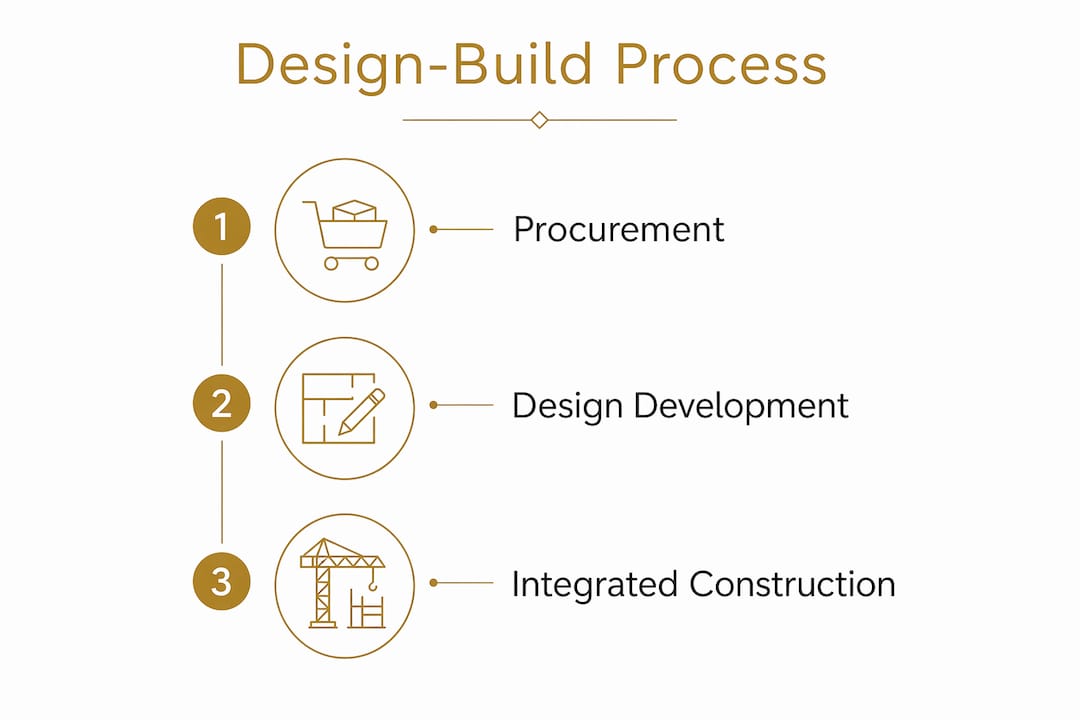
The design-build process follows three primary phases: procurement, collaborative design development, and integrated construction. Understanding each phase helps you anticipate your role and your obligations as an owner.
1. Procurement The owner selects a design-build firm based on qualifications, past performance, and preliminary pricing. Unlike design-bid-build, where price is the dominant selection criterion, design-build procurement rewards demonstrated expertise and team cohesion. Requests for Qualifications (RFQs) and Requests for Proposals (RFPs) are the standard tools.
2. Collaborative Design Development The design-build team develops schematic designs, cost estimates, and construction documents simultaneously. The owner reviews design iterations alongside real-time cost feedback. This phase is where your active participation pays off most directly.
3. Integrated Construction Site work can begin while design finalizes on later phases, enabling schedule compression that is impossible in sequential delivery models. Foundation work may proceed while interior specifications are still being refined.
Pricing structures in design-build contracts take three common forms. A Guaranteed Maximum Price (GMP) caps the owner’s exposure while allowing cost savings to be shared. A lump sum fixes the price but requires more design certainty upfront. Cost-plus arrangements reimburse actual costs plus a fee, offering transparency but less budget predictability. Contract pricing models like GMP require owner engagement on cost changes during design, because design choices directly affect the final number.
Payment schedules tie to project milestones such as foundation completion, framing, and drywall installation. Most contracts also include retainage clauses.
Pro Tip: Request a detailed milestone schedule before signing. Knowing exactly when payments trigger and what deliverables must be complete at each stage protects you from disputes over incomplete work and keeps the team accountable.
Design-build vs. traditional methods: what are the real advantages?
The difference between design-build and traditional delivery methods is measurable, not just theoretical. Research from Terrapin Construction Group shows that design-build projects deliver 33.5% faster and achieve 6.1% cost savings compared to design-bid-build. That is not a marginal improvement. For a $10 million commercial project, 6.1% represents $610,000 in savings before you negotiate a single change order.
Design-build also produces 3.8% less cost growth and 2.4% less cost growth than Construction Manager at Risk (CMAR). Cost growth is the metric that matters most to business owners, because it represents the gap between what you budgeted and what you actually paid.
The table below compares the three primary delivery methods across the factors that matter most to commercial project owners.
| Factor | Design-Build | Design-Bid-Build | CMAR |
|---|---|---|---|
| Accountability | Single entity | Split between designer and contractor | Shared, with CM as intermediary |
| Schedule | 33.5% faster than DBB | Baseline | Moderate improvement over DBB |
| Cost Growth | 3.8% less than DBB | Baseline | 2.4% more than DB |
| Owner Admin Burden | Low | High | Moderate |
| Design Flexibility | High during early phases | Limited after bid | Moderate |
| Dispute Risk | Low | High | Moderate |
The collaboration benefits extend beyond schedule and cost. When the contractor is involved from the first design session, budget constraints shape design decisions in real time. There is no moment where an architect hands over drawings and a contractor says the design cannot be built for the agreed price. That conversation happens continuously, which is why cost control is structurally stronger in design-build than in any sequential delivery model.
High-end home builders in Agua Dulce using integrated delivery methods demonstrate that these advantages scale from commercial projects down to complex residential builds, where the same coordination challenges apply.
What should a design-build contract actually include?
A well-structured design-build agreement covers six critical areas. Missing any one of them creates exposure that can cost you far more than the time it takes to negotiate them upfront.
- Scope of work: The contract must define what the design-build entity is responsible for delivering, including design documents, permits, construction, and commissioning. Vague scope language is the primary source of change order disputes.
- Pricing structure: Specify whether the contract is GMP, lump sum, or cost-plus, and define how design choices that affect cost will be communicated and approved.
- Payment schedule: Tie every payment to a defined milestone. Retainage clauses typically hold 5–10% of payments until project completion, protecting the owner if final punch-list items are incomplete.
- Change order procedures: Define the process for identifying, pricing, and approving changes before work begins. Unforeseen site conditions, owner-requested modifications, and code changes all generate change orders. A clear procedure prevents delays.
- Dispute resolution: Because design and construction liability are combined under one contract, dispute resolution clauses are structurally more complex than in traditional agreements. Predefine whether disputes go to mediation, arbitration, or litigation, and in what sequence.
- Design review rights: Specify when and how the owner reviews and approves design documents. This protects you from receiving a finished building that does not match your operational requirements.
The GMP model deserves special attention. It gives owners cost certainty while preserving the collaborative benefits of design-build. However, it requires the owner to engage actively during design, because design choices affect cost dynamically. Waiting until construction documents are complete to raise cost concerns eliminates the flexibility that makes GMP valuable.
Pro Tip: Hire a construction attorney with design-build experience to review dispute resolution language before you sign. Detangling design and construction liabilities mid-project is complex and expensive. Clear contract language prevents that scenario entirely.
Does design-build reduce owner control? clearing up the misconceptions
The most common objection to design-build contracts is that owners lose control over design decisions. This is incorrect. Design-build fosters collaboration and gives owners more influence through early engagement, not less.
In a traditional design-bid-build model, the owner approves a design, then hands it to a contractor who had no input. Changes after that point are expensive and slow. In design-build, the owner participates in design decisions alongside the contractor and architect from day one. That means your operational requirements, aesthetic preferences, and budget constraints shape the design before it is locked in.
Consider what this means for value engineering. Early value engineering during schematic design can recover 8–15% of hard costs through material and system alternatives. Waiting until construction documents are complete eliminates that opportunity entirely. The owner who engages early captures those savings. The owner who stays passive does not.
Practical ways to maximize your control in a design-build project:
- Attend every design review meeting and bring your operations team, not just your project manager.
- Request written cost impact statements for every design decision above a defined threshold.
- Establish a clear approval chain so design changes do not stall waiting for internal sign-off.
- Define your non-negotiables in writing before the design process begins, covering program requirements, material standards, and operational constraints.
Owner accountability in design-build is a two-way relationship. The more clearly you communicate your goals, the more effectively the design-build team can deliver them.
When should a business use a design-build contract?
Owners select design-build for commercial, industrial, and infrastructure projects where complex coordination and faster delivery are priorities. The model is not the right fit for every project, but it is the right fit for more projects than most business owners realize.
Design-build is the strongest choice when:
- Schedule is the primary constraint. Overlapping design and construction phases compresses timelines in ways that sequential delivery cannot match.
- The project involves complex coordination. Subterranean structures, large-scale mechanical systems, and specialized installations benefit from having designers and builders in the same room from the start.
- Budget certainty matters more than design flexibility. A GMP contract with active owner engagement delivers predictable costs without sacrificing quality.
- The owner lacks construction management capacity. Single-point accountability reduces the internal resources required to manage a project.
- The project is large-scale commercial or industrial. Distribution centers, manufacturing facilities, medical office buildings, and data centers are among the project types where design-build consistently outperforms traditional delivery.
For construction estimating on complex projects, resources like TradeBid’s construction insights offer useful context on how integrated delivery affects subcontractor bidding and cost modeling.
Builtblackbriar applies these same principles to high-end residential and commercial builds in Los Angeles, where complex site conditions and demanding client specifications require exactly the kind of integrated coordination that design-build delivers.
Key takeaways
Design-build contracts give business owners a single accountable team, faster schedules, and measurable cost savings over traditional delivery methods when owners engage actively from the start.
| Point | Details |
|---|---|
| Single contract, one team | Design and construction responsibility sits with one entity, eliminating split accountability. |
| Proven schedule and cost gains | Design-build delivers 33.5% faster and 6.1% less cost than design-bid-build. |
| Active owner engagement matters | Early participation in design reviews captures 8–15% in value engineering savings. |
| Contract terms define your protection | GMP pricing, retainage clauses, and dispute resolution language must be clearly defined before signing. |
| Best fit for complex, time-sensitive projects | Commercial, industrial, and infrastructure projects with coordination demands benefit most from this model. |
What i have learned after years of complex project delivery
Working through complex builds in Los Angeles, I have seen design-build contracts succeed and fail. The difference almost always comes down to owner engagement, not contractor quality.
The firms that struggle with design-build are the ones that treat it like a traditional contract. They hand over a program, step back, and expect a finished building. They miss the design review meetings. They delay cost impact approvals. Then they are surprised when the final product does not reflect their vision or their budget.
The firms that succeed show up. They bring their operations team to schematic design sessions. They ask hard questions about cost implications before decisions are locked in. They read the dispute resolution clause before they sign it, not after a problem surfaces.
One thing I advocate for consistently is selecting a design-build firm based on communication practices, not just portfolio. Ask how they structure design review meetings. Ask how they handle cost changes during design. Ask for references from owners who were actively involved. The answers reveal whether the firm genuinely integrates the owner into the process or just uses design-build as a marketing label.
The contract language matters too. Vague scope definitions and weak change order procedures are the two most common sources of project disputes. A qualified construction attorney reviewing the agreement before signing is not an optional expense. It is the most cost-effective investment you can make before breaking ground.
Design-build is a genuinely better delivery model for the right projects. But it requires a different kind of owner. One who is present, informed, and willing to make decisions early. If that describes you, this model will reward you with a faster, more cost-effective project than traditional delivery can offer.
— Daniel
How Builtblackbriar delivers integrated design-build projects
Builtblackbriar brings the discipline of integrated project delivery to high-end builds across Los Angeles, where complex site conditions and demanding specifications require exactly the kind of unified accountability that design-build provides.

From subterranean basements to oversized glass installations, Builtblackbriar’s process keeps clients informed and involved at every phase, with technology-driven communication that eliminates the information gaps that derail traditional projects. If you are planning a complex commercial or luxury residential build, explore Builtblackbriar’s full range of building services or visit the luxury home builders in Los Angeles page to see how integrated delivery works in practice. When your project demands on-time, on-budget results, let’s build together.
FAQ
What is a design-build contract in simple terms?
A design-build contract is a single agreement where one entity handles both the design and construction of a project. The owner deals with one team and one contract instead of managing separate relationships with an architect and a general contractor.
How does design-build differ from design-bid-build?
In design-bid-build, the owner hires a designer first, then solicits bids from contractors who had no role in the design. Design-build combines both under one contract, which reduces disputes, compresses schedules, and produces 6.1% lower costs on average.
What pricing models are used in design-build contracts?
Design-build contracts commonly use Guaranteed Maximum Price (GMP), lump sum, or cost-plus pricing. GMP caps owner exposure while allowing cost savings to be shared, but it requires active owner engagement during the design phase to be effective.
Does a design-build contract reduce my control as an owner?
No. Design-build gives owners more influence through early collaboration, not less. Owners who participate actively in design reviews can capture 8–15% in value engineering savings that are unavailable in traditional sequential delivery models.
What types of projects benefit most from design-build contracts?
Commercial, industrial, and infrastructure projects with complex coordination requirements and schedule-driven delivery benefit most. Distribution centers, medical office buildings, and manufacturing facilities are among the project types where design-build consistently outperforms traditional delivery methods.