

May 28, 2026
How to Hire a Luxury Home Builder That Delivers

Deciding to hire a luxury home builder is one of the most consequential choices a high-net-worth homeowner will make. Custom luxury home construction is not simply a scaled-up version of standard residential building. It involves intricate engineering, highly personalized specifications, and a level of coordination that can make or break both the project timeline and the investment. The right builder translates your architectural vision into a finished structure with precision and care. The wrong one turns years of planning into a costly, frustrating experience. This guide walks you through a structured, expert-driven process to find, vet, and work with the best custom luxury home builder for your needs.
Table of Contents
- Key takeaways
- What to look for when you hire a luxury home builder
- A step-by-step process to vet luxury home builders
- What to expect during pre-construction and construction
- Verifying quality and wrapping up the project
- My perspective on what separates good builders from great ones
- How Builtblackbriar supports your luxury build from start to finish
- FAQ
Key takeaways
| Point | Details |
|---|---|
| Vet multiple builders thoroughly | Research and compare 3 to 5 qualified candidates, checking licenses, insurance, portfolios, and references before deciding. |
| Prioritize operational management | Communication and scheduling practices predict project success more reliably than credentials alone. |
| Lock selections early | Finalizing design details during the pre-construction window prevents costly rework and cascading delays later. |
| Understand what drives pricing | Luxury home costs reflect engineering complexity, site conditions, and material refinement, not just square footage. |
| Verify quality at completion | Conduct structured walkthroughs and review warranty terms before signing off on the finished project. |
What to look for when you hire a luxury home builder
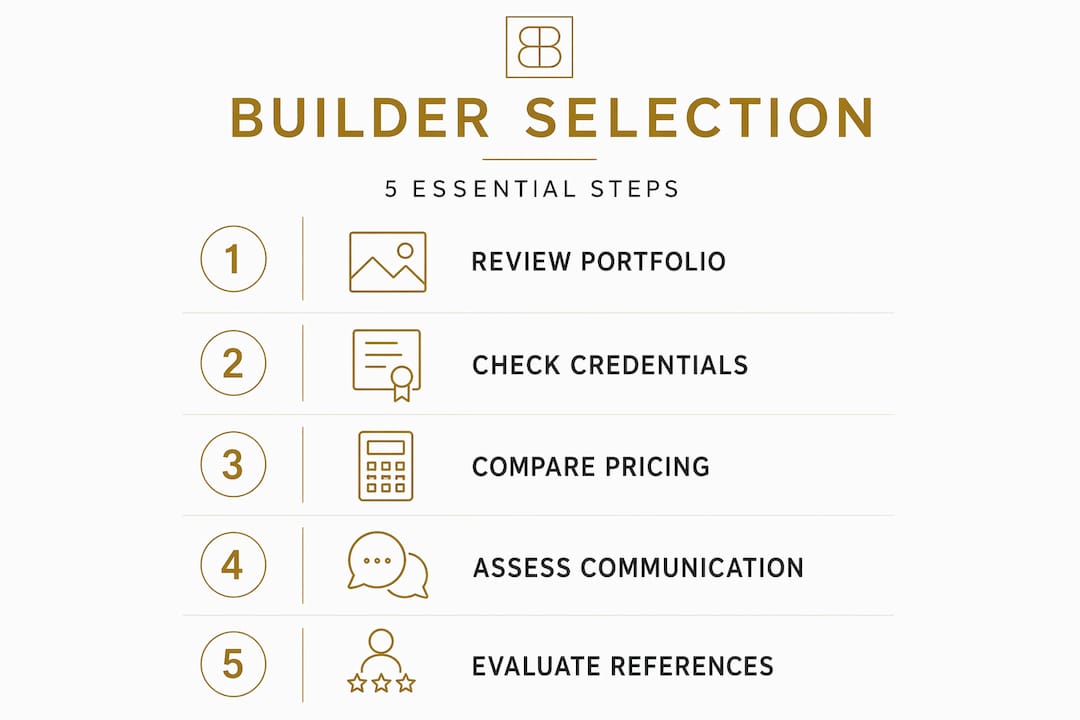
The formal term for this decision-making process is custom home builder selection, and it deserves the same rigor you would apply to any significant financial or legal decision. Many homeowners begin by simply reviewing websites and looking at beautiful photography. That is a reasonable starting point, but it reveals almost nothing about how a builder actually operates under pressure.
Licenses, insurance, and credentials
Before anything else, confirm that any builder you consider holds a valid state contractor’s license and carries both general liability insurance and workers’ compensation coverage. These are baseline requirements, not differentiators. What separates capable builders from exceptional ones comes down to the operational factors behind those credentials.
Portfolio quality and project scope
Request portfolios that include projects similar in scope to yours, meaning comparable square footage, structural complexity, and custom finish levels. A builder with a strong track record in standard residential work may not be equipped for a subterranean basement or a three-story glass curtain wall. Ask specifically whether their completed projects involved the same level of detailing you expect. Luxury home prices vary widely based on engineering complexity and site conditions rather than just size, so your builder’s experience with comparable scopes matters significantly.
Pricing models and contract terms
Understand whether the builder works on a fixed-price contract, a cost-plus model, or a hybrid arrangement. Each carries different risk profiles for you as the client. Fixed-price contracts provide budget certainty but may include contingency padding. Cost-plus arrangements give more transparency into actual costs but require close monitoring. Ask to review a sample contract before any commitment, paying close attention to change order procedures, payment schedules, and warranty coverage.
Communication and project management structure
This is where many homeowners underestimate the stakes. Operational factors like communication cadence and subcontractor coordination are among the strongest predictors of on-time, on-budget outcomes. Ask how the builder handles weekly updates, who your primary point of contact will be, and how decisions are documented. A builder who cannot articulate a clear communication protocol is a risk, regardless of how impressive their past projects appear.

Pro Tip: Ask each builder to describe the last project that ran into an unexpected delay and how they resolved it. The specificity and ownership in their answer tells you more than any portfolio ever will.
A step-by-step process to vet luxury home builders
Approaching builder selection with a defined sequence removes emotion from the process and gives you a reliable framework for comparison. Here is the process that consistently surfaces the right builder for complex, high-value projects.
-
Research and shortlist. Identify 3 to 5 builders with demonstrated experience in luxury home construction at the tier you are targeting. Use local architectural firms, real estate attorneys, and design professionals as referral sources rather than relying solely on online searches. Builders who receive consistent referrals from these professionals tend to have strong reputations for delivery.
-
Conduct structured interviews. Prepare a consistent set of questions for every builder so you can make direct comparisons. Cover topics like their current project load, how they handle subcontractor relationships, and what their typical pre-construction process looks like. Asking detailed process questions reveals far more about potential performance than simply reviewing portfolios and online reviews.
-
Visit completed and active builds. Photographs of finished homes are curated. Visiting an active construction site, with the builder’s permission, shows you how organized the site is, how workers behave, and how materials are stored and managed. A well-run job site is a direct reflection of a well-run company.
-
Check references with specific questions. Go beyond asking whether the client was satisfied. Ask whether the project finished on schedule, how the builder handled unexpected problems, and whether they would hire that builder again for a more complex project. Patterns across multiple references are far more informative than a single glowing endorsement.
-
Compare proposals in detail. When you receive formal proposals, vet each builder’s approach to pricing, scope definition, change order management, and project timeline side by side. A lower initial bid that lacks clear change order documentation can easily become the most expensive option before a project is finished.
| Evaluation factor | What to look for | Red flag |
|---|---|---|
| License and insurance | Current, verified, appropriate scope | Expired or absent documentation |
| Portfolio scope | Projects matching your complexity | Only residential or small-scale work |
| Communication protocol | Defined cadence, documented decisions | Vague or informal update process |
| Change order process | Written approvals, tracked costs | Verbal agreements, unclear pricing |
| References | On-time delivery, repeat clients | Reluctance to provide contacts |
Pro Tip: Request a reference from a client whose project encountered a significant scope change. How the builder managed that moment, financially and relationally, is the clearest window into what your experience will be.
What to expect during pre-construction and construction
Understanding the phases ahead helps you stay in control rather than reacting to events as they unfold. Most homeowners are surprised by how much critical decision-making happens before a single foundation pour.
The pre-construction window
After contract signing, a 4 to 12 week preparation period is standard before construction begins. This time is used for finalizing architectural and structural documents, securing permits, confirming material selections, and coordinating the subcontractor schedule. It is also the period most likely to be rushed, which creates downstream problems. The pre-construction stage is where delays most commonly originate. Locking selections and approvals in this window protects against rework, material substitutions, and schedule compression later.
| Pre-construction task | Why it matters |
|---|---|
| Finalize architectural drawings | Prevents costly mid-build design changes |
| Secure all permits | Avoids work stoppages and legal exposure |
| Confirm material selections | Eliminates substitution and lead time surprises |
| Align subcontractor schedule | Reduces gaps between trades on-site |
| Establish communication cadence | Sets expectations for the entire build |
Managing the active build
Once construction starts, your role shifts from decision-maker to engaged observer and approver. Regular site visits, scheduled update calls, and documented approvals for any changes are the habits that keep a project on track.
- Request weekly written updates that cover completed milestones, upcoming work, and any open items requiring your decision.
- Review and approve all change orders in writing before the work proceeds. Verbal approvals have no contractual standing and are a leading source of budget disputes.
- Understand that subcontractor scheduling is one of the most complex parts of luxury home construction. Your builder’s ability to sequence trades (structural, mechanical, electrical, plumbing, finishes) without long gaps directly affects both timeline and quality.
- If you are building in a region with specific site challenges, such as hillside lots, expansive soils, or setback restrictions common in Los Angeles, confirm that these conditions are addressed in the structural documents before the schedule begins.
Verifying quality and wrapping up the project
The final phase of any custom luxury home build is more involved than most clients anticipate. A thorough close-out process protects your investment and sets up the home for long-term performance.
- Conduct a formal walkthrough with your builder and, if possible, with your own independent inspector. Use a written punch list to document every item requiring completion, adjustment, or correction. Do not sign off on final payment until the punch list is resolved.
- Understand your warranty terms in detail before the project closes. Standard new construction warranties typically cover workmanship for one year, mechanical systems for two years, and structural elements for ten years, though these terms vary by builder and state. Confirm what is covered, what is excluded, and who to contact for warranty claims.
- Collect all project documentation at close-out, including as-built drawings, product warranties, subcontractor contacts, and maintenance schedules for specialty systems. This documentation is not just practical for maintenance. It materially supports resale value when buyers and their attorneys review the build record.
- Establish a post-construction support contact with the builder. Top-rated luxury home builders maintain a dedicated point of contact for the post-occupancy period, typically the first 12 months, to address any issues that emerge as the home settles and systems are tested under real conditions.
My perspective on what separates good builders from great ones
I’ve spent years watching luxury home projects from the inside, and I’ll tell you honestly: the builders who consistently deliver are not always the ones with the most impressive marketing or the longest list of completed projects. The ones who earn repeat business and referrals are the ones who treat project management as seriously as craftsmanship.
What I’ve learned is that license and insurance checks, while necessary, tell you almost nothing about what the next 18 months of your life will look like. The ultra-luxury construction segment is resilient in 2026, driven largely by cash buyers with long-term residence intent rather than financing pressure. That means your competition for the best builders is real. The builders with the strongest operational systems are in demand, and they know it.
My honest advice: weight your decision heavily toward how a builder manages communication, documents change orders, and coordinates subcontractors. A builder who can articulate exactly how decisions get made and tracked will almost always outperform one who relies on relationships and reputation alone. The paperwork is not bureaucracy. It is the architecture of accountability. And in a project that can span two years and multiple millions of dollars, that architecture matters as much as the one on the blueprints.
— Daniel
How Builtblackbriar supports your luxury build from start to finish

Builtblackbriar has built its reputation in Los Angeles by doing the things described in this guide exceptionally well. Their process integrates real-time technology platforms that keep clients informed at every phase, from permit approvals through final walkthrough. They specialize in technically complex builds, including subterranean basements and large-scale glass installations, that require the kind of precise coordination most builders are not equipped to manage. Clients consistently cite their luxury home building services for on-time, on-budget performance and a communication model that removes uncertainty from the process. Whether you are building in West Hollywood, Westlake, or another high-end Los Angeles neighborhood, Builtblackbriar brings the operational discipline and design sensitivity that sophisticated clients require. Reach out to begin a consultation and see how their approach translates your vision into a finished home.
FAQ
How do I start the process to hire a luxury home builder?
Begin by identifying 3 to 5 qualified builders with portfolios that match your project’s scope and complexity, then conduct structured interviews focused on operational management and communication practices rather than credentials alone.
What questions should I ask a custom luxury home builder?
Ask how they handle change orders, who manages subcontractor scheduling, what their weekly communication process looks like, and whether they can provide references from clients whose projects experienced significant scope changes.
How long does luxury home construction typically take?
Custom luxury home construction typically spans 12 to 24 months from contract signing, with a 4 to 12 week pre-construction planning period before site work begins, depending on project complexity and permit timelines.
What drives the cost of a luxury custom home?
Luxury home costs are driven primarily by engineering complexity, material refinement, and site conditions rather than square footage alone, which is why detailed scope alignment with your builder early in the process is critical.
Is it worth hiring an independent inspector for a luxury home build?
Yes. An independent inspector provides an unbiased evaluation of construction quality at key milestones and at final walkthrough, offering a layer of verification that protects your investment beyond what the builder’s own quality control provides.