

July 1, 2026
How to Review a Luxury Construction Contract in 2026

A luxury construction contract review is the process of carefully analyzing every clause to protect your investment before a single dollar changes hands. Builder-provided contracts are drafted primarily to protect the builder, not the homeowner, which means the burden of scrutiny falls entirely on you. The industry term for this process is “contract analysis,” and it covers scope, payment terms, timelines, warranties, and dispute resolution. Early contract review is the single most effective way to maintain negotiation leverage before deposits become non-refundable. This guide gives homeowners and investors the exact framework to evaluate high-end construction agreements with confidence.
What are the essential elements to check in a luxury construction contract?
The scope of work section is the foundation of any high-end construction agreement. It must describe every material, finish, and system by brand, model, and specification. Vague language like “comparable materials” gives the builder permission to substitute lower-quality products without your approval. Any change order process should require written authorization from you before work begins or costs are incurred.
Payment terms deserve equal attention. Deposits should be held by an independent escrow agent, not deposited into the builder’s operating account. Reputable luxury builders structure warranties covering workmanship for 1 year, mechanical systems for 2 years, and major structural defects for 10 years. Written express warranties typically supersede statutory protections, so confirm the contract’s warranty terms meet or exceed your state’s requirements.

The project timeline section must include a substantial completion date and a “drop-dead” termination date. A substantial completion drop-dead date is typically set 60–120 days after the projected completion, with extensions limited to documented force majeure events only. Without this clause, a builder can delay indefinitely with no financial consequence.
Dispute resolution language shapes how conflicts get resolved without destroying the project relationship. Mandatory mediation clauses provide a structured path to resolution before litigation becomes necessary. Construction attorney Abby Cote emphasizes that contracts must blend strong dispute resolution with support for a cooperative builder-client relationship.
Key elements to verify in any luxury construction agreement:
- Scope of work: Specific materials, finishes, and substitution approval rights
- Payment schedule: Milestone-based draws tied to verified completion stages
- Retainage: Capped at 5% and released upon final inspection approval
- Completion dates: Projected date plus a hard drop-dead termination date
- Warranty terms: Workmanship, systems, and structural coverage periods in writing
- Dispute resolution: Mediation first, arbitration second, litigation as last resort
- Escrow protection: Deposits held by a neutral third-party escrow agent
Pro Tip: Request a copy of the builder’s standard contract at least 30 days before your target signing date. This gives your legal advisor time to review it without pressure and lets you negotiate from a position of knowledge, not urgency.
How to identify and mitigate financial risk in luxury construction contracts
The contract type determines who absorbs cost overruns. Fixed-price contracts provide a set total cost and shift overrun risk to the builder. Cost-plus contracts place all financial risk on the homeowner, since you pay actual costs plus a builder fee regardless of how high costs climb.
Guaranteed maximum price (GMP) contracts appear to offer protection, but the ceiling is typically set 10–15% above initial estimates. Builders tend to spend near the cap because the structure creates little incentive for cost discipline. A fixed-price contract with a fully locked design and scope is the most protective structure for homeowners.
- Identify the contract type first. Confirm whether the agreement is fixed-price, cost-plus, or GMP before reviewing any other clause. This single factor determines your baseline financial exposure.
- Check deposit terms and escrow requirements. Non-refundable deposits without escrow protection are a direct financial risk. Builder incentives often push buyers toward preferred lenders by eliminating financing contingencies for outside financing, which can cost you your deposit if your loan falls through.
- Review retainage limits carefully. Retainage should be limited to 5% of the contract value. Courts in many jurisdictions will not rewrite contracts with higher retainage; they void the unenforceable provisions instead, which can leave you with no leverage at project close.
- Locate indemnification clauses. Broad indemnification language can require homeowners to indemnify builders even for the builder’s own negligence. This is an unfair liability shift that a construction attorney can negotiate out of the contract.
- Verify financing contingency protections. If you plan to use a lender other than the builder’s preferred partner, confirm the contract does not eliminate your financing contingency. Losing this protection means losing your deposit if financing falls through.
Pro Tip: Ask the builder to provide a line-item cost breakdown alongside the contract. In a fixed-price agreement, this breakdown reveals whether the scope is fully defined. Gaps in the breakdown often signal undefined scope that will generate costly change orders later.
For a practical starting point, a renovation contracts checklist covers many of the same legal verification points that apply to new luxury construction agreements.
Step-by-step process for reviewing and negotiating a luxury construction contract
A structured review process prevents overlooked clauses from becoming expensive surprises. The table below maps each review stage to its primary objective and the professional best suited to lead it.
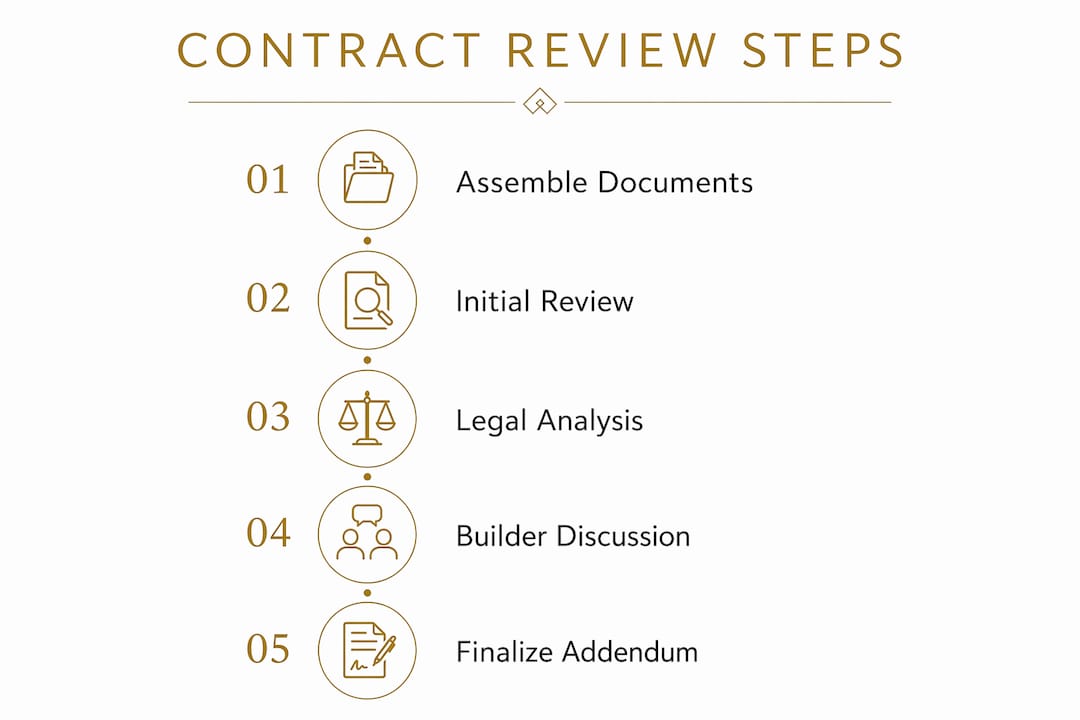
| Review Stage | Primary Objective | Who Leads |
|---|---|---|
| Document assembly | Gather contract, specs, and plans | Homeowner |
| Initial read-through | Flag unclear or missing terms | Homeowner |
| Legal review | Identify unenforceable or risky clauses | Construction attorney |
| Financial analysis | Assess payment terms and cost exposure | Real estate advisor |
| Negotiation | Revise deposits, timelines, and warranties | Attorney with homeowner |
| Compliance check | Verify alignment with 2026 state laws | Attorney |
| Amendment documentation | Record all agreed changes in writing | Both parties |
The process works best when you treat it as sequential, not parallel. Skipping the legal review to save time is the most common and costly shortcut homeowners take.
Before engaging professionals, prepare your own initial review using a checklist. Mark every clause you do not fully understand. Pay particular attention to:
- Supplementary conditions buried deep in the contract (often pages 20 and beyond)
- Any clause that limits your right to terminate or recover deposits
- Definitions of “substantial completion” and how disputes about completion are resolved
- Insurance and bonding requirements for the builder and all subcontractors
Once your attorney completes the legal review, schedule a direct conversation with the builder’s representative to address flagged items. Builders who refuse to discuss contract terms are a warning sign. Reputable builders expect negotiation on luxury projects and treat it as part of establishing a professional relationship. When you ask key questions of your contractor before signing, you learn as much about the builder’s character as you do about the contract terms.
Document every agreed amendment as a written addendum, signed by both parties, before you sign the base contract. Verbal agreements made during negotiation have no legal standing once the contract is executed.
Common mistakes that undermine luxury construction projects
The most expensive mistakes in high-end construction contract analysis happen before the project starts. Homeowners who skip or rush the review process pay for it in change order disputes, delayed completions, and lost deposits.
“Supplementary conditions many pages into contracts often include risk-shifting clauses like broad indemnification and ‘no-damage-for-delay’ provisions. These clauses can waive your remedies when delays are caused by the builder, leaving you with no recourse and a stalled project.”
The most frequently overlooked errors include:
- Accepting vague completion definitions. Contracts that define completion as “when the builder determines the home is ready” give the builder unilateral control over the timeline and your deposit.
- Ignoring escrow requirements. Deposits paid directly to a builder’s operating account are at risk if the builder faces financial difficulty during construction.
- Missing “no-damage-for-delay” clauses. These provisions waive your right to compensation when builder-caused delays push your completion date back by months.
- Relying on AI contract review tools alone. AI tools are about 5 times less accurate than human experts when interpreting complex construction contracts. They miss nuanced risk-shifting language and misleading clause structures that experienced attorneys catch immediately.
- Failing to lock design before signing. Successful fixed-price contracts require fully locked design and scope before execution. Signing a fixed-price contract with undefined finishes creates an open-ended cost structure that defeats the purpose of the fixed-price model.
- Overlooking builder incentive structures. When a builder offers significant incentives to use their preferred lender, read the financing contingency clause immediately. The incentive often comes at the cost of your deposit protection.
Key Takeaways
Thoroughly reviewing a luxury construction contract before signing protects your deposit, defines your legal rights, and holds the builder accountable to a clear scope, timeline, and budget.
| Point | Details |
|---|---|
| Review before any deposit | Early review preserves negotiation leverage before deposits become non-refundable. |
| Prefer fixed-price contracts | Fixed-price agreements shift cost overrun risk to the builder, not the homeowner. |
| Cap retainage at 5% | Retainage above 5% may be unenforceable and leaves you without leverage at project close. |
| Require independent escrow | Deposits held by a neutral escrow agent are protected if the builder faces financial difficulty. |
| Use human legal review | AI tools are about 5 times less accurate than attorneys at identifying complex contract risks. |
What I’ve learned from watching homeowners sign without reading
The pattern I see most often is this: a homeowner falls in love with a builder’s portfolio, gets excited about the project, and signs the contract the same week they tour the model home. The contract review becomes a formality rather than a filter. That excitement is understandable. It is also the most expensive mistake you can make on a seven-figure project.
The contracts that cause the most damage are not the ones with obviously bad terms. They are the ones with reasonable-sounding language that quietly shifts risk. A “no-damage-for-delay” clause reads like standard boilerplate. It is not. It means you absorb the financial cost of a builder’s scheduling failures with no legal remedy.
My strongest recommendation is to treat the contract review as the first real test of your builder relationship. A builder who resists negotiation on deposit escrow or retainage limits is telling you something important about how they will handle disputes during construction. The builders worth working with expect scrutiny and welcome it. They know that a clearly negotiated contract protects both sides.
Lock your design completely before you sign anything. A fixed-price contract with undefined finishes is not a fixed-price contract. It is a cost-plus contract with a ceiling that will be exceeded. The discipline of finalizing every specification before signing forces both you and the builder to think through the project in detail, which is exactly where problems get caught before they become change orders.
— Daniel
Builtblackbriar’s approach to luxury contract transparency
Homeowners evaluating a complex luxury build in Los Angeles deserve a builder who treats contract clarity as a professional standard, not an afterthought.

Builtblackbriar brings that standard to every project. The team’s luxury home building expertise covers the full spectrum of high-end construction in Los Angeles, from subterranean basements to oversized glass installations. Clients receive detailed project documentation, milestone-based payment schedules, and direct access to project managers throughout every phase. Builtblackbriar’s process is built around transparency: clear scope definitions, written change order protocols, and technology-driven communication that keeps homeowners informed at every stage. If you are preparing to sign a luxury construction agreement and want a builder whose contracts reflect genuine accountability, start the conversation with Builtblackbriar today.
FAQ
What should I review first in a luxury construction contract?
Start with the payment terms and deposit escrow requirements. Deposits held outside of independent escrow and non-refundable deposit clauses represent the highest immediate financial risk before construction begins.
What is a reasonable retainage amount in a luxury construction contract?
Retainage should be capped at 5% of the contract value. Higher percentages may be unenforceable in many jurisdictions, and courts often void those provisions rather than rewrite them.
How does a fixed-price contract protect homeowners?
A fixed-price contract sets a total cost and transfers cost overrun risk to the builder. It works only when the design and scope are fully locked before signing; otherwise, change orders erode the fixed-price protection.
Can I use AI tools to review a luxury construction agreement?
AI tools can flag basic issues but are about 5 times less accurate than human experts on complex construction contracts. Always pair any automated review with a qualified construction attorney for high-end projects.
What is a “no-damage-for-delay” clause and why does it matter?
A “no-damage-for-delay” clause waives your right to financial compensation when builder-caused delays push back your completion date. This clause is one of the most financially damaging provisions in luxury construction contracts and should be negotiated out before signing.