

June 13, 2026
How to Select a Commercial General Contractor in 2026

Selecting a commercial general contractor (GC) means confirming the firm is legally compliant, financially stable, experienced in your specific project type, and capable of communicating clearly from day one. The industry term is “commercial general contractor,” and the selection process differs meaningfully from hiring a residential builder. Property owners and businesses that skip formal vetting routinely face budget overruns, regulatory delays, and workmanship disputes. This guide covers every stage of commercial contractor selection, from credential verification through bid analysis and final interviews, so you can make a confident, well-documented decision.
How to select a commercial general contractor: credentials first
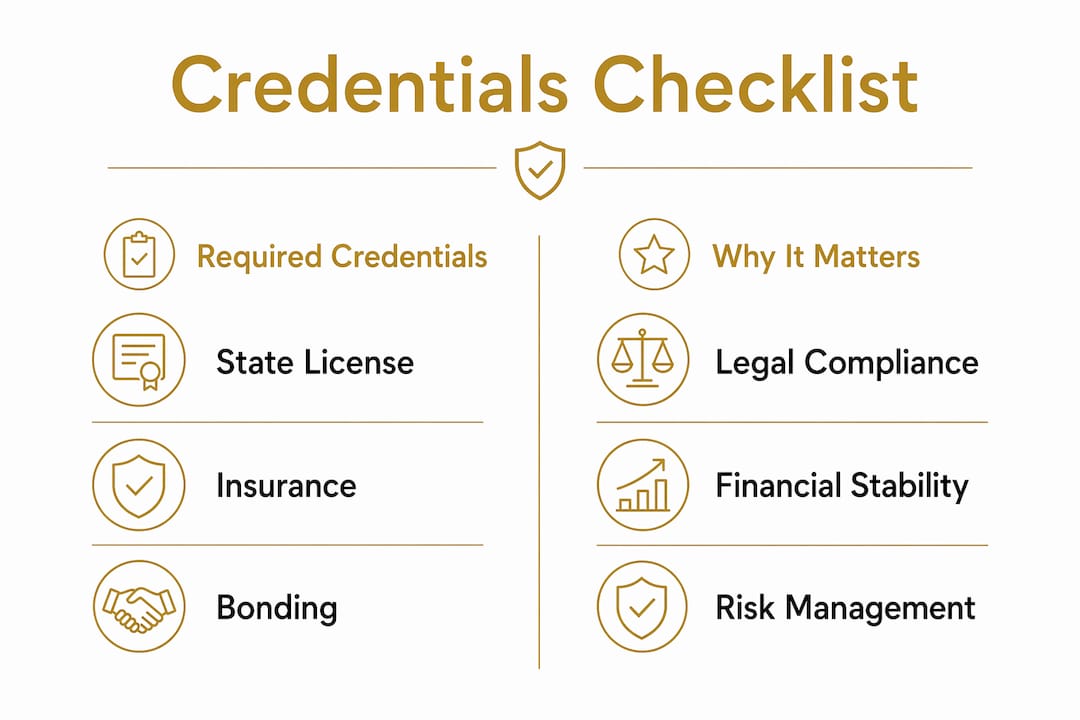
Verifying credentials upfront is the single most important step in commercial contractor selection. An active state license, current insurance certificates, and confirmed bonding capacity tell you whether a firm is legally authorized to work and financially capable of finishing the job.
What licenses and insurance must a commercial GC carry?
The core documents you need to request before any other conversation:
- State contractor’s license. Confirm the license number is active through your state licensing board. Unlicensed work voids most insurance policies and exposes you to personal liability.
- General liability insurance. Minimum coverage levels vary by state and project size, but commercial projects typically require $1 million per occurrence and $2 million aggregate.
- Workers’ compensation insurance. Required in every state for firms with employees. A lapse here means you could be liable for on-site injuries.
- Umbrella policy. For larger commercial builds, request evidence of an umbrella policy that extends coverage beyond primary limits.
One detail most owners miss: a Certificate of Insurance (COI) does not guarantee you are covered as an Additional Insured. Endorsement wording must be reviewed to confirm coverage scope for both ongoing and completed operations. A contractor can hand you a valid COI and still leave you exposed if the endorsement language excludes your project type.
Pro Tip: Request the actual policy endorsement forms, not just the COI. Ask specifically whether Additional Insured coverage applies to completed operations, since construction defect claims often surface months after project closeout.
How does bonding capacity signal contractor reliability?
Bonding capacity signals financial strength and surety approval. A contractor with ready bonding capacity handles scope changes and payment disruptions more reliably than one who cannot secure bonds. For California public works projects, performance and payment bonds are typically required at 100% of contract value. That standard exists because it protects both the owner and subcontractors if the GC defaults mid-project.
| Credential | What to Request | Why It Matters |
|---|---|---|
| State License | Active license number | Confirms legal authority to build |
| General Liability | COI plus endorsement forms | Covers property damage and injury claims |
| Workers’ Comp | Current certificate | Protects against on-site injury liability |
| Performance Bond | Bond commitment letter | Guarantees project completion |
| Payment Bond | Bond commitment letter | Protects subcontractors from nonpayment |
How do you compare commercial contractor bids effectively?
Requesting at least three written bids with detailed scopes, timelines, and material specifications is the standard practice for avoiding hidden costs. One bid gives you a price. Three bids give you a market.
What to look for in a line-item bid
- Scope alignment. Each bid must cover identical work. If one contractor excludes electrical rough-in and another includes it, you are not comparing prices. You are comparing different projects.
- Material specifications. Require brand names and product grades where relevant. “Framing lumber” is not the same as “Douglas Fir #2 or better.” Vague specs invite substitutions.
- Schedule realism. A bid with an unusually compressed timeline is a risk. Ask how the contractor plans to staff the project and whether the schedule accounts for permit review periods.
- Warranty terms. Commercial GCs should offer a minimum one-year workmanship warranty. Longer terms on specific systems (roofing, waterproofing) indicate confidence in their subcontractors.
- Change order process. Require a written change order clause that mandates signed approval and agreed pricing before any additional work begins.
Mismatched scope and weak change-order control are the most common causes of cost overruns in commercial construction. Written approvals before work proceeds are not bureaucratic overhead. They are your primary financial protection.
Low bid price alone is a risk indicator because it often signals missing scope or underestimated costs. The contractor who wins on price and then issues change orders for every excluded item costs more in the end than the mid-range bidder who scoped the job correctly.

Pro Tip: Use a bid comparison spreadsheet or a platform like TradeBid to align line items side by side. Standardizing the format before you send out bid packages forces contractors to price the same scope, which makes your comparison genuinely apples-to-apples.
| Bid Element | Red Flag | Green Flag |
|---|---|---|
| Total price | Significantly below other bids | Within 10–15% of median bid |
| Scope description | Vague or missing line items | Detailed with material specs |
| Schedule | Unrealistically compressed | Phased with permit buffer built in |
| Change order clause | Verbal or absent | Written, signed approval required |
| Warranty | Not mentioned | Minimum one year, in writing |
What questions should you ask before hiring a commercial GC?
Structured interview questions reveal how a contractor actually operates, not just how they present themselves. The goal is to assess site management, communication discipline, and safety culture before you sign anything.
Ask every finalist these questions directly:
- Who manages the site daily? You want a named superintendent, not a vague answer about “our team.” The superintendent is your primary point of contact during construction.
- How do you communicate progress to the owner? Look for a defined cadence: weekly written reports, shared project management software (Procore, Buildertrend, or similar), and scheduled site walks.
- What is your process for change orders? The answer should describe written documentation, pricing approval before work starts, and a log that tracks all changes against the original contract.
- What is your EMR (Experience Modification Rate)? An EMR below 1.0 correlates with fewer on-site incidents and fewer project delays. An EMR above 1.0 signals a history of worker injuries that statistically increases your project risk.
- How do you select and manage subcontractors? Top-rated general contractors maintain a vetted subcontractor list and hold subs to the same insurance and safety standards they apply to their own crews.
Communication quality during the interview predicts communication quality during construction. A contractor who answers questions with specifics, names, and documented processes will manage your project the same way. One who speaks only in generalities will manage it the same way too.
You can also review how firms like Builtblackbriar approach contractor communication and change order management as a reference point for what professional standards look like in practice.
Why does sector-specific experience matter for commercial projects?
A commercial building contractor is not simply a residential GC working on a larger structure. The distinction between a general contractor and a commercial contractor includes different licensing tiers, code requirements, permitting workflows, and stakeholder coordination demands. Hiring a firm without relevant sector experience is one of the most common and costly mistakes property owners make.
Commercial sectors each carry distinct regulatory and construction requirements:
- Medical and healthcare facilities require compliance with FGI Guidelines, OSHPD oversight in California, and specialized MEP (mechanical, electrical, plumbing) coordination.
- Retail and hospitality demand fast-track schedules, phased occupancy planning, and coordination with brand standards.
- Office and mixed-use involve complex tenant improvement coordination, ADA compliance, and often occupied-building protocols.
- Industrial and warehouse require specific structural loading, fire suppression systems, and dock or utility infrastructure.
Sector-specific permitting experience reduces the risk of regulatory delays and costly mistakes. A contractor who has pulled permits for medical tenant improvements in Los Angeles County knows the plan check timeline, the required inspections, and the agency contacts. A contractor doing it for the first time will learn on your budget and your schedule.
“Require evidence of at least two to three completed projects similar in type, scale, and regulatory complexity to your own. References from those project owners are more valuable than any portfolio photograph.”
You can also explore how commercial project roles are structured to better understand what a GC is responsible for versus what falls to the owner or design team.
Key takeaways
Selecting the right commercial general contractor requires verified credentials, comparable written bids, structured interviews, and confirmed sector-specific experience before any contract is signed.
| Point | Details |
|---|---|
| Verify credentials first | Confirm active license, insurance endorsements, and bonding capacity before any other evaluation. |
| Request three written bids | Align scopes line by line to expose hidden costs and scope gaps across competing proposals. |
| Demand written change orders | Require signed approval and agreed pricing before any additional work begins to prevent budget creep. |
| Check EMR and safety records | An EMR below 1.0 signals lower project risk and fewer schedule disruptions from on-site incidents. |
| Match sector experience | Confirm the GC has completed projects in your specific commercial sector with verifiable references. |
What i have learned about picking the right commercial GC
After managing client projects across Los Angeles, I have watched owners make the same selection mistake repeatedly: they choose on price and discover the real cost later. The low bidder who wins the job often wins it because they scoped less, not because they build better.
The contractors I trust most share one trait. They answer hard questions with specifics. When you ask about their change order process and they hand you a one-page written procedure, that tells you something real. When they name their superintendent and describe the reporting cadence before you ask, that tells you something real too.
I have also seen owners skip the endorsement review on insurance certificates and regret it. A COI is a summary document. The endorsement is the actual contract language. Those two documents do not always say the same thing, and the endorsement is the one that controls.
My honest recommendation: build a short scoring matrix before you interview. Weight credentials at 30%, bid clarity at 30%, communication and safety at 25%, and sector experience at 15%. Score each finalist objectively. The matrix will not make the decision for you, but it will stop emotion and price from overriding the factors that actually predict project success.
— Daniel
Build with confidence: explore builtblackbriar’s services
Property owners who have worked through this vetting process know how rare it is to find a builder who meets every standard: verified credentials, transparent bids, disciplined communication, and genuine sector expertise.

Builtblackbriar brings that standard to luxury home building in Los Angeles and complex residential projects across Southern California. From subterranean basements to oversized glass installations, Builtblackbriar integrates project management technology that keeps clients informed at every phase. If you are ready to move from vetting to building, explore Builtblackbriar’s full services or reach out directly to discuss your project scope and timeline.
FAQ
What credentials must a commercial general contractor carry?
A commercial GC must hold an active state contractor’s license, current general liability and workers’ compensation insurance, and bonding capacity appropriate to the contract value. Request endorsement forms alongside the COI to confirm Additional Insured coverage is actually in place.
How many bids should you get for a commercial project?
Request at least three written bids with matching scopes, material specifications, and schedule details. Fewer bids limit your ability to identify scope gaps or pricing outliers that signal risk.
What does EMR mean and why does it matter?
EMR stands for Experience Modification Rate, a measure of a contractor’s workers’ compensation claim history relative to industry averages. An EMR below 1.0 indicates a safer-than-average record and correlates with fewer project delays.
Why is sector-specific experience critical for commercial builds?
Different commercial building types carry distinct code requirements, permitting workflows, and stakeholder coordination demands. A contractor without experience in your sector will encounter regulatory surprises that cost you time and money.
What is the biggest risk in commercial contractor selection?
Choosing on price without verifying scope alignment is the leading cause of budget overruns. A low bid that omits scope items generates change orders that routinely exceed the savings from the original price difference.