

June 1, 2026
The Role of Project Manager in Commercial Builds

The project manager in commercial construction is defined as the single accountable leader who integrates schedule, cost, contracts, quality, and stakeholder coordination across every phase of a build. This role, formally recognized in the Project Management Body of Knowledge (PMBOK) as a program integrator, carries direct responsibility for financial outcomes, contractual compliance, and client satisfaction from the first design meeting through final occupancy. The role of project manager in commercial builds is not a support function. It is the operational and commercial spine of the entire project. Without disciplined project management in commercial real estate and institutional construction, even well-funded projects routinely finish late, over budget, and in dispute.
What are the core day-to-day responsibilities of a commercial construction PM?
Project managers coordinate trades, subcontractors, designers, clients, and regulatory bodies through all project phases, from initial planning through defects resolution. That coordination is not passive. It requires active daily management of information, money, time, and people simultaneously.
The daily work of construction project oversight falls into five interconnected categories:
- Schedule management: Monitoring progress against the baseline program and critical path, identifying float erosion early, and issuing formal notices when delays threaten milestone dates.
- Contract administration: Reviewing and certifying pay applications, processing change orders, and maintaining the formal record of every instruction issued or received.
- Cost control: Updating cost forecasts at least monthly, incorporating approved variations and risk impacts to prevent budget deterioration before it becomes unrecoverable.
- Stakeholder communication: Translating technical progress into clear reporting for owners, lenders, and design teams while managing design information flow to prevent schedule slippage.
- Change management: Evaluating scope changes for time and cost impact before approving them, not after. Unapproved changes are the single most common cause of commercial construction disputes.
Execution management also involves monitoring contract administration, change control, and stakeholder coordination as a unified system, not as separate tasks handled by separate people.
Pro Tip: Build a two-week look-ahead schedule every Friday and distribute it to all trade foremen before Monday morning. This single habit catches resource conflicts before they become delay events.

The PM’s scope also extends to procurement oversight, reviewing subcontractor submittals, coordinating inspections, and managing the flow of Requests for Information (RFIs). On larger commercial projects, a PM may oversee a team that includes a site manager, a cost manager, and a document controller. The PM’s job is to keep all of those functions aligned to a single project outcome.
How does the PM role differ from site manager and construction manager?
PM roles differ widely by organization. Some firms blend site and project management into one position, while others separate strategic and operational responsibilities distinctly. Understanding where those lines fall matters for both hiring decisions and stakeholder expectations.
| Role | Primary focus | Contract authority | Client relationship |
|---|---|---|---|
| Project Manager | Budget, schedule, contracts, commercial outcomes | Full authority over variations and claims | Primary client contact |
| Construction Manager | Subcontractor coordination, site logistics, safety | Limited to site-level instructions | Reports to PM |
| Site Manager | Daily trade scheduling, quality inspections, safety compliance | None beyond site instructions | Minimal direct contact |
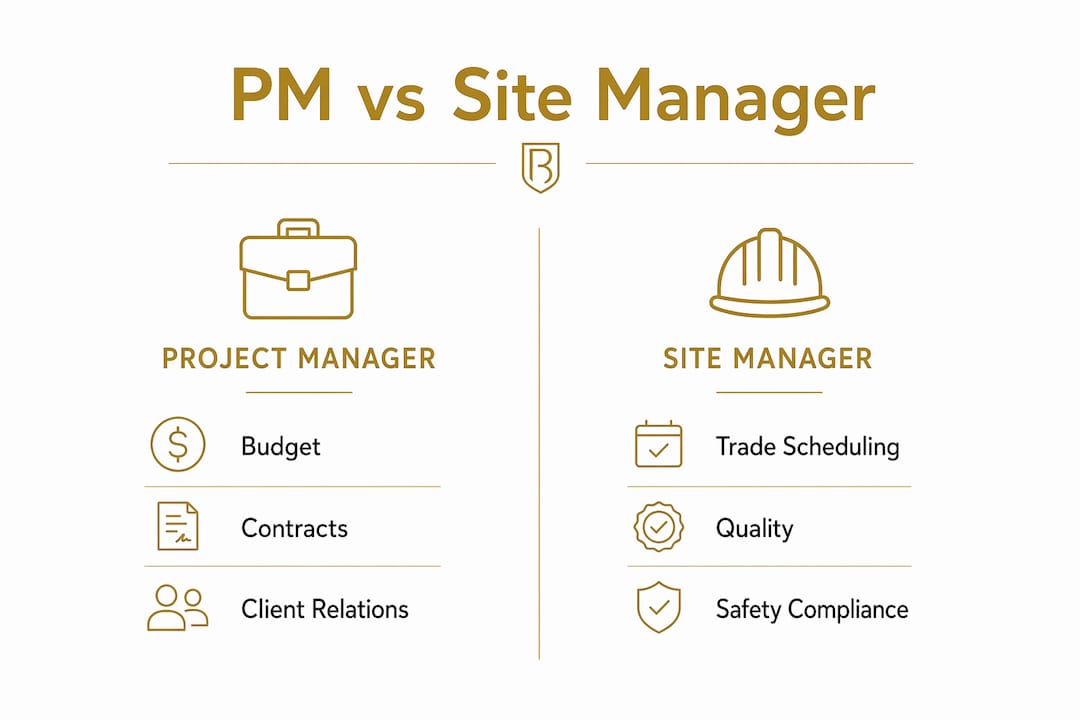
The project manager holds the broadest accountability. A site manager who is excellent at sequencing trades and enforcing quality standards may have no visibility into contract terms, liquidated damages clauses, or cash flow forecasting. A construction manager may overlap with cost control and subcontractor management on mid-size projects, but typically does not carry the contractual authority to approve change orders or negotiate with the client on commercial matters.
Project management and oversight functions must remain distinct. A PM overseeing their own work complicates independent validation and risk management, which is why larger commercial projects often separate the owner’s representative from the delivery PM entirely. On complex builds in markets like Los Angeles, where entitlement risk, soil conditions, and design complexity intersect, that separation protects all parties.
What critical skills empower project managers in commercial builds?
PMBOK principles define project management as the integration of schedule, cost, and risk into a unified delivery system. The PMs who consistently deliver commercial projects on time and within budget are not simply organized people. They carry a specific set of technical and interpersonal competencies that most job descriptions understate.
The most consequential skills for commercial construction management include:
- Contract literacy: Understanding subcontract clauses, notice requirements, liquidated damages provisions, and variation approval processes. Contractual authority defines the PM’s accountability boundaries, and missing a contractual notice deadline can make a legitimate claim unrecoverable.
- Integrated cost and schedule management: Treating budget and program as one system, not two separate reports. A schedule delay always has a cost consequence, and a cost overrun often traces back to a schedule event.
- Communication as a strategic tool: Effective communication requires tailoring information for diverse stakeholders and proactively managing design information flow. Delayed design responses cause schedule slippage. PMs who actively track and enforce response commitments protect their programs.
- Safety leadership: Construction PMs are responsible for safety culture, not just compliance. This means site presence, stopping unsafe work, and creating an environment where trades report hazards without fear.
- Proactive risk management: Identifying risks before they become issues, quantifying their schedule and cost impact, and building contingency plans that are managed as controlled inputs rather than emergency responses.
Pro Tip: Create a contract map at project kickoff that lists every notice period, approval deadline, and milestone payment trigger. Review it monthly alongside your cost forecast. This single document has prevented more disputes than any other tool in commercial construction management.
Leadership under pressure deserves specific mention. Commercial builds involve dozens of competing interests, tight deadlines, and high financial stakes. The PM who can hold a difficult conversation with a subcontractor, de-escalate a client concern, and still close out the day’s RFI log is the PM who delivers. Technical knowledge without interpersonal authority produces reports, not results. Architecture master planning and integrated design coordination also require PMs to understand BIM (Building Information Modeling) data delivery, since BIM has become standard on commercial projects and PMs must manage its outputs, not just acknowledge its existence.
How do commercial project managers manage closeout and handover?
Closeout is the phase most frequently underestimated in commercial project management, and it is the phase that most directly determines whether a client considers the project a success. Closeout duties include managing defects liability, commissioning, regulatory approvals, and comprehensive handover documentation. PMs who treat closeout as a wind-down period rather than a structured phase routinely deliver incomplete packages and face extended defects liability periods.
A disciplined closeout follows this sequence:
- Compile the snag list at practical completion and assign each defect to a responsible trade with a contractual rectification deadline. Do not allow verbal commitments to substitute for written records.
- Coordinate commissioning and testing for all mechanical, electrical, and plumbing (MEP) systems. Each system requires witnessed testing, signed test certificates, and formal sign-off from the relevant engineer of record.
- Obtain regulatory approvals including occupancy certificates, fire authority sign-offs, and any jurisdiction-specific inspections required before the building can be legally occupied. In Los Angeles, this includes LADBS (Los Angeles Department of Building and Safety) final inspection.
- Assemble operation and maintenance (O&M) documentation for every installed system. This includes manufacturer warranties, maintenance schedules, spare parts lists, and as-built drawings. Incomplete O&M packages are a common source of post-handover disputes.
- Secure formal client acceptance in writing, referencing the contract’s practical completion definition. This triggers the defects liability period clock and, on most contracts, releases the retention held by the client.
Many commercial disputes reduce to documentation conflicts. PMs who maintain detailed records for every approval, RFI, pay application, and variation protect their projects from claims that would otherwise be impossible to defend. Closeout is where that documentation discipline pays its most visible dividend.
Key takeaways
The project manager in commercial construction is the single point of accountability for integrating contracts, schedule, cost, quality, and stakeholder communication from pre-construction through final handover.
| Point | Details |
|---|---|
| PM as integrator | The PM unifies schedule, cost, contracts, and communication into one delivery system across all project phases. |
| Contract literacy is non-negotiable | Understanding notice periods, variation approvals, and liquidated damages clauses directly protects project cash flow. |
| Monthly forecasting discipline | Cost forecasts updated monthly with approved variations and risk impacts prevent budget deterioration before it becomes unrecoverable. |
| Closeout demands equal rigor | Snag lists, commissioning, O&M documentation, and formal acceptance must be managed with the same discipline as construction execution. |
| Role clarity drives outcomes | Distinguishing PM, construction manager, and site manager responsibilities prevents accountability gaps and protects all stakeholders. |
What separates good PMs from great ones, in my experience
I have worked alongside project managers who produced immaculate Gantt charts and missed every commercial risk hiding in plain sight inside the subcontract. And I have worked with PMs who ran their projects from a single notebook and never lost a dollar to an unapproved change. The difference was not organizational skill. It was contract literacy and the discipline to enforce it under pressure.
The real commercial impact of PMs lies in protecting project profitability through accurate contract administration, change order management, and cost forecasting. That is not a soft skill. It is a technical competency that requires deliberate development. The PMs who get this right develop their contract map before the first shovel moves, not after the first dispute letter arrives.
Early involvement in procurement and scope definition is the other factor that separates high performers. A PM who joins a project after the subcontracts are signed inherits every ambiguity the design team left unresolved. A PM who participates in scope definition and procurement can close those gaps before they become change orders. On complex builds, including subterranean structures and large-format glass installations, that early involvement is not optional. It is the difference between a project that delivers and one that litigates.
— Daniel
How Builtblackbriar delivers expert project management for complex builds

Builtblackbriar brings the full spectrum of commercial construction management to high-end projects across Los Angeles, integrating contract administration, cost control, and schedule oversight into a single accountable delivery structure. Every project benefits from transparent reporting, proactive change management, and direct client communication at every phase. For clients pursuing complex builds, including subterranean basements, oversized glass installations, and technically demanding luxury structures, Builtblackbriar’s project management services provide the contract-literate, schedule-disciplined leadership that protects both investment and timeline. Explore Builtblackbriar’s luxury construction expertise to understand how integrated project management translates into on-time, on-budget delivery for discerning clients.
FAQ
What is the primary role of a project manager in commercial builds?
The project manager is the single accountable leader responsible for integrating schedule, cost, contracts, quality, and stakeholder coordination from pre-construction through final handover. This role carries direct authority over change orders, pay applications, and commercial outcomes.
How does a commercial PM differ from a site manager?
A site manager focuses on daily trade scheduling, quality inspections, and safety compliance on the physical site. The project manager holds broader accountability for contracts, budget, client relationships, and commercial success across the entire project lifecycle.
What contract knowledge does a commercial PM need?
A commercial PM must understand subcontract clauses, notice requirements, liquidated damages provisions, and variation approval processes. Missing a contractual notice deadline can make a legitimate delay or cost claim unrecoverable.
Why is project closeout so important in commercial construction?
Closeout determines whether a client receives a fully functional, legally compliant, and documented building. Incomplete commissioning records, missing O&M documentation, or unsigned acceptance certificates expose the PM and the owner to extended liability and potential disputes.
How often should a commercial PM update cost forecasts?
Cost forecasts should be updated at least monthly, incorporating all approved variations and identified risk impacts. Regular monthly financial updates allow PMs to manage cash flow proactively and prevent budget deterioration from becoming unrecoverable.