

May 21, 2026
What Full-Service Luxury Construction Means for Homeowners

When clients ask what does full-service luxury construction mean, the answer goes far deeper than premium finishes and high price tags. Many homeowners and investors assume the term simply refers to expensive materials or upscale aesthetics. The reality is more consequential: full-service luxury construction describes a unified, integrated delivery model where one firm holds accountability for every phase of your project, from initial design concept through final occupancy. Understanding this distinction before you sign a contract can change your entire experience, your budget outcome, and the finished quality of your home.
Table of Contents
- Key takeaways
- What full-service luxury construction means, defined
- What’s actually included in a full-service project
- Benefits homeowners and investors can expect
- Key considerations and pitfalls to watch for
- A full-service project from consultation to move-in
- My perspective on what this model actually delivers
- Build with confidence in Los Angeles
- FAQ
Key takeaways
| Point | Details |
|---|---|
| Single-point accountability | One firm manages design, construction, and delivery under a single contract, reducing conflict and confusion. |
| Preconstruction saves money | Investing 2 to 5% upfront in preconstruction planning significantly reduces costly surprises during the build. |
| Turnkey means truly finished | Full-service delivery includes permits, inspections, and handoff, not just framing and drywall. |
| Scope clarity protects you | Always verify in writing which specific services, especially permitting, are included in your contract. |
| Integration improves quality | Real-time cost feedback between designers and builders produces homes that are both beautiful and buildable within budget. |
What full-service luxury construction means, defined
The term draws its core meaning from two related delivery models: design-build and turnkey contracting. Under a single-point accountability model, one entity holds the contract with the owner, giving the client one team, one contract, and an integrated process from concept through completion. This is fundamentally different from the traditional fragmented approach, where an owner hires an architect separately, then a general contractor, then specialists, each with their own contracts and competing loyalties.
In traditional construction, this fragmentation creates an adversarial dynamic. The architect blames the contractor for misreading the drawings. The contractor blames the architect for impractical details. The owner absorbs the delays and cost overruns. Full-service construction eliminates that friction by design.
Pro Tip: Ask any firm claiming to offer full-service luxury construction to describe exactly who holds the contract. If the answer splits responsibility between an architecture firm and a separate GC, you are not dealing with a true single-contract model.
The table below contrasts the two delivery approaches on the dimensions that matter most to homeowners and investors:
| Factor | Full-service (design-build/turnkey) | Traditional (segmented) |
|---|---|---|
| Contract structure | Single contract with one firm | Separate contracts for architect, GC, subs |
| Budget transparency | Real-time cost feedback during design | Costs unknown until bids are received |
| Accountability | One team owns outcomes | Responsibility is shared and often disputed |
| Decision-making speed | Faster, internal collaboration | Slower, requires external coordination |
| Risk exposure | Lower for the owner | Higher, especially for scope changes |
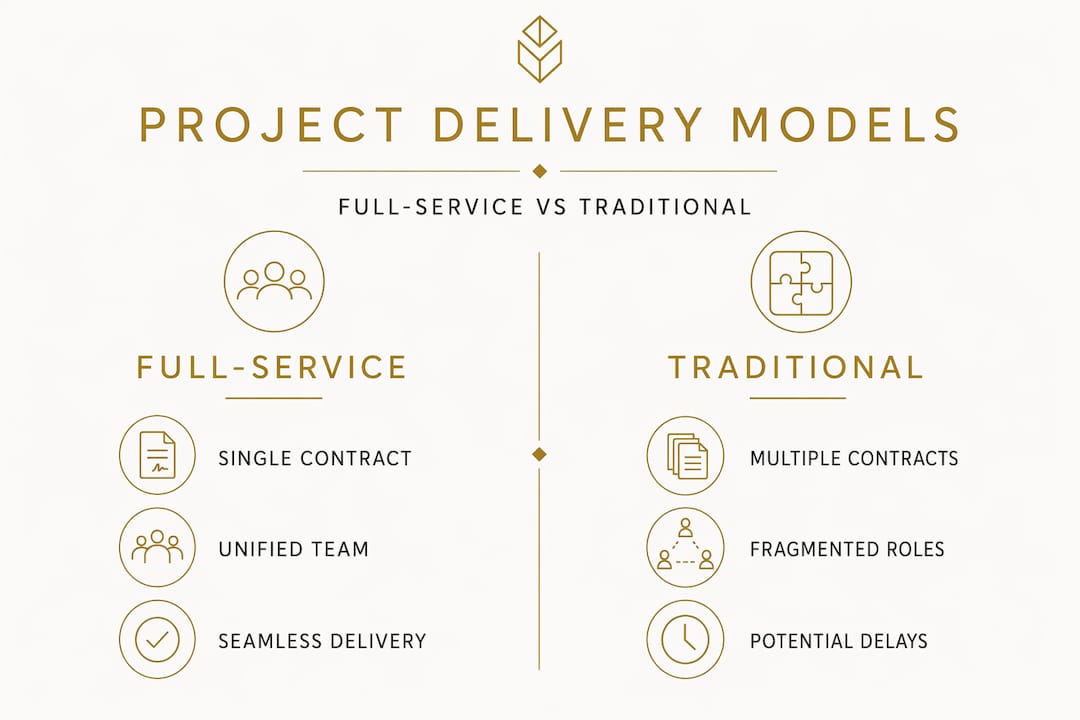
The design-build approach allows builders and designers to collaborate from day one, providing real-time cost feedback during design development so expensive changes after drawings are complete become rare rather than routine.
What’s actually included in a full-service project
The word “full” carries serious weight. A genuine full-service firm manages every phase of your project lifecycle, not just the construction phase. Understanding what that covers gives you a clear picture of what you are paying for and why the investment is justified.
Preconstruction services form the foundation. This phase includes:
- Concept development and site analysis to identify structural constraints early
- Budget alignment, ensuring your design ambitions match financial reality before a single permit is pulled
- Value engineering, the process of finding alternative materials or methods that preserve design intent while reducing cost
- Scheduling, building a realistic timeline that accounts for permit lead times, material procurement, and subcontractor availability
- Permitting and jurisdictional compliance, handled on your behalf so you are not navigating municipal bureaucracy alone
Once construction begins, the firm manages subcontractor coordination, materials procurement, on-site quality inspections, and progress reporting. Preconstruction planning is particularly critical for aligning client expectations and ensuring constructability, reducing surprises and confirming that scope is complete before ground breaks.
The final phase covers inspections, documentation, certificate of occupancy, and a formal handover that leaves the home genuinely ready for move-in. Under a turnkey contract, the contractor manages budgeting, permitting, procurement, scheduling, and inspections to deliver a completed, ready-for-occupancy property under a single agreement.
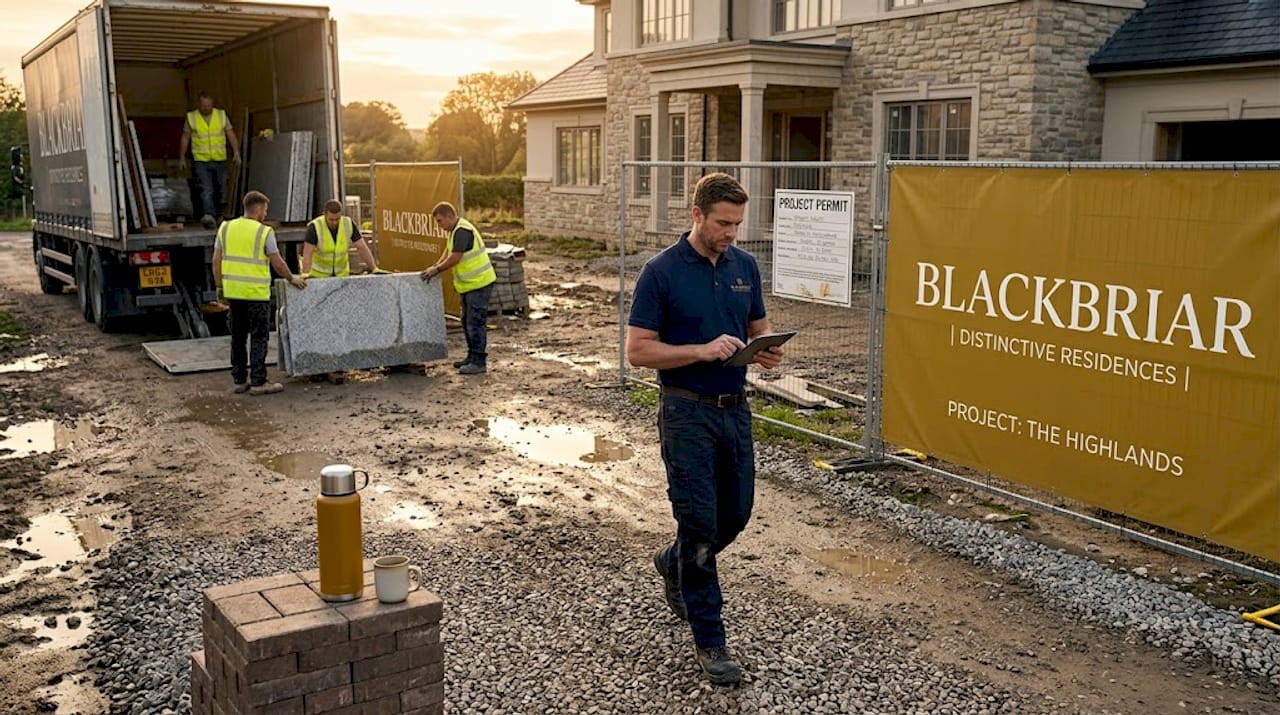
Pro Tip: Request a detailed scope-of-services document before signing anything. A reputable full-service firm should be able to list, phase by phase, every responsibility it assumes. Gaps in that list are gaps in your protection.
Benefits homeowners and investors can expect
Choosing a full-service luxury builder changes the ownership experience in ways that go beyond convenience. Here is what that difference looks like in practice:
-
Reduced administrative burden. You are not tracking down separate contracts, chasing architects for revisions, or mediating disputes between your GC and your structural engineer. One team handles those conversations internally. The permit and inspection management alone, tasks that are genuinely time-intensive in Los Angeles’s permitting environment, can represent dozens of hours you keep for yourself.
-
Predictable budgets. Because early contractor involvement in preconstruction allows real-time cost feedback, the likelihood of staying within budget increases substantially. You get a realistic number before construction starts, not a shock discovery after drawings are finalized.
-
Faster decision-making. When the same team that designs your home also builds it, there are no handoff delays between disciplines. A design question gets answered by someone who will actually construct the solution.
-
Quality assurance with integrated oversight. Because the builder’s reputation depends on the final product, not just the construction phase, the incentive to use quality materials and workmanship runs through the entire project. There is no finger-pointing when the same entity is responsible for everything.
-
Reduced scope creep. Scope creep (the gradual expansion of work beyond the original plan) is one of the most common causes of budget overruns in luxury projects. Full-service firms manage change orders centrally, giving you clear visibility into the cost implications of every modification before it is approved.
Turnkey solutions appeal particularly to high-income homeowners and investors who value clear accountability and simplified project oversight. That appeal is rational, not just a matter of preference.
Key considerations and pitfalls to watch for
Not every firm that uses the phrase “full-service” actually delivers the model described above. Before you commit, there are specific contract details that deserve careful scrutiny.
-
Verify permitting scope in writing. Some firms claim turnkey or design-build status but exclude permitting from their responsibilities. Permitting responsibilities must be explicitly documented, as some contracts shift jurisdictional compliance tasks back to the owner without making that obvious in the proposal.
-
Understand preconstruction fees upfront. Preconstruction investment typically runs 2 to 5% of the project budget. That is real money, but it is offset by reduced risk, fewer change orders, and a significantly higher probability of finishing on time and on budget. Firms that skip this phase are not saving you money. They are shifting risk onto you.
-
Distinguish design-build from turnkey. Design-build emphasizes the integration of design and construction services. Turnkey emphasizes delivery of a completely finished product. Some firms specialize in one; genuinely full-service firms provide both. Ask specifically which model applies to your project and how each phase transitions.
-
Vet integration depth, not just claimed capabilities. Ask the firm how their architects and builders communicate during design. If the answer is “they meet weekly,” that is traditional coordination, not true integration. Real integration means cost and constructability feedback happens in real time, not at scheduled intervals.
Pro Tip: When selecting a custom home builder, ask for a sample project timeline and a sample scope-of-services agreement. These documents reveal quickly whether a firm’s process is genuinely integrated or just marketed that way.
A full-service project from consultation to move-in
To make the process concrete, here is what a well-managed full-service luxury construction project looks like from start to finish:
-
Initial consultation. The client team, including lead architect, project manager, and estimator, meets with the homeowner or investor to understand vision, site constraints, and financial parameters. This is not a sales meeting. It is a discovery session that informs every decision downstream.
-
Preconstruction phase. Concept designs are developed in parallel with cost modeling. Every design decision generates a budget implication, reviewed before the design advances. This phase ends when the owner has a confirmed budget, a realistic schedule, and a complete set of permit-ready drawings.
-
Permitting and procurement. The firm files permits, engages subcontractors through a vetted process, and orders long-lead materials (specialty glass, custom millwork, imported stone) while permits are pending. In Los Angeles, this overlap can save months.
The following table shows approximate timelines for a complex custom luxury build:
| Phase | Typical duration | Owner involvement |
|---|---|---|
| Initial consultation and design | 8 to 14 weeks | High |
| Preconstruction and permitting | 12 to 24 weeks | Moderate |
| Construction | 40 to 80 weeks | Low to moderate |
| Final inspections and handover | 2 to 4 weeks | High |
-
Construction and quality management. The project manager coordinates subcontractors and conducts regular site inspections against approved drawings. The owner receives structured progress updates (not informal texts) at defined intervals.
-
Final handover. The completed home passes all required inspections, receives a certificate of occupancy, and is delivered with full documentation including warranties, maintenance guides, and as-built drawings. The owner turns the key on a genuinely finished home.
My perspective on what this model actually delivers
I’ve watched homeowners approach luxury construction with the assumption that hiring expensive professionals guarantees a smooth experience. It does not. What determines the outcome is not the caliber of any individual on the team. It is the accountability structure holding them together.
In my experience, the projects that go sideways almost always share one characteristic: a fragmented contract structure where no single party owned the full outcome. When the architect and the builder answer to different contracts, the space between their responsibilities becomes the owner’s problem. I’ve seen that gap cost clients six figures in disputed scope and extended timelines.
What I’ve found to actually work is a model where the same team that draws the home also builds it, where cost feedback informs design in real time rather than arriving as a shock when bids come in. That is not a minor process preference. It changes the nature of the entire project.
My advice to any homeowner or investor considering a high-end build: do not evaluate firms based on their portfolio alone. Evaluate their accountability structure. Ask who gets called when something goes wrong. If the answer involves a conversation between separate parties, you are bearing the risk that conversation fails.
— Daniel
Build with confidence in Los Angeles

For homeowners and investors in Los Angeles who want the clarity, control, and quality that a genuine full-service model provides, Builtblackbriar delivers exactly that. From initial concept through final handover, Builtblackbriar’s luxury home building services operate under a single, accountable team that manages design, preconstruction, permitting, procurement, and construction without fragmentation or finger-pointing.
Builtblackbriar specializes in technically complex builds, including subterranean basements, oversized structural glass installations, and architecturally demanding hillside sites, the projects where integrated oversight matters most. Clients consistently report on-time, on-budget completions and deep involvement at every phase of their project. Whether you are building in West Hollywood, Studio City, or across the broader Los Angeles region, Builtblackbriar’s full-service construction offerings are designed around your project’s specific ambitions. Schedule a consultation to see what single-point accountability looks like in practice.
FAQ
What does full-service mean in luxury construction?
Full-service luxury construction means one firm manages every phase of the project, from design and preconstruction through permitting, building, and final handover, under a single contract. This model gives the owner one point of accountability and eliminates the disputes common in fragmented, multi-contract approaches.
How is design-build different from traditional construction?
In a design-build model, one entity holds the contract for both design and construction, enabling real-time cost feedback and integrated decision-making. Traditional construction splits those responsibilities between separate firms, increasing the risk of miscommunication and cost overruns.
What does preconstruction include and why does it matter?
Preconstruction covers budgeting, scheduling, value engineering, and permit preparation before construction starts. This upfront investment, typically 2 to 5% of the budget, dramatically reduces the risk of budget surprises and scope disputes during the build.
How do I verify whether a builder is truly full-service?
Ask for a written scope-of-services document that lists every responsibility by project phase, and confirm in writing that permitting is included. Firms that cannot produce this document clearly, or that exclude permitting from their scope, are not offering a genuinely full-service model.
Is full-service luxury construction worth the higher upfront cost?
For complex builds and high-value properties, the integrated model reliably reduces total project cost by catching design and budget misalignments early. The reduced administrative burden, fewer change orders, and higher likelihood of on-time delivery make the premium a sound investment for most homeowners and investors.