

June 2, 2026
What Is a Construction Management Agreement?

A construction management agreement is a legally binding contract that formally appoints a construction manager to oversee a building project, defining their scope of services, compensation, risk allocation, and administrative authority on behalf of the project owner. Unlike a general contractor arrangement, the construction manager’s role centers on planning, coordination, and risk management rather than performing physical construction work on site. This distinction shapes every clause in the agreement and determines how much financial exposure the owner retains. Whether you are planning a custom home in Los Angeles or a large commercial development, understanding this contract is the first step toward a project that finishes on time and within budget. Organizations like the AIA (American Institute of Architects), Procore, and Rocket Lawyer each publish frameworks and templates that reflect industry-standard practice.
What is a construction management agreement and what does it define?
A construction management agreement is the legal instrument that transforms an informal working relationship into a defined professional engagement. It specifies exactly what the construction manager (CM) is hired to do, what authority they hold, how they are paid, and what happens when things go wrong. Without this document, both the owner and the CM operate on assumptions that courts cannot enforce.
The agreement draws a clear boundary between management and construction. Owners typically hire construction managers because they lack the internal resources to coordinate architects, engineers, subcontractors, and permitting agencies simultaneously. The CM fills that gap professionally, but only within the limits the agreement sets. A well-drafted contract prevents the CM from making financial commitments the owner never authorized.

AIA Contract Documents, widely regarded as the industry standard in the United States, publish separate contract families for different CM delivery models. Rocket Lawyer and similar platforms offer accessible templates for smaller projects. The underlying structure across all of them follows the same logic: define the project, define the services, define the money, and define the exit.
What roles and responsibilities does a construction management agreement assign?
The agreement assigns the CM a portfolio of administrative and managerial duties that would otherwise fall on the owner. These typically include budget tracking, schedule management, design coordination, subcontractor procurement, quality oversight, and regulatory compliance monitoring. The CM acts as the owner’s professional representative throughout the project lifecycle.
Specific authority granted to the CM varies by project and delivery model, but common examples include:
- Advertising bids and receiving proposals from trade contractors
- Evaluating subcontractor qualifications and recommending awards
- Reviewing and approving shop drawings and submittals
- Managing requests for information (RFIs) between the design team and field
- Tracking change orders and reporting cost impacts to the owner
- Coordinating inspections and permit closeouts
The owner retains final decision-making authority on major expenditures, design changes, and contract awards unless the agreement explicitly delegates those powers. Authority clauses serve as a critical control mechanism, limiting the CM’s ability to bind the owner to financial commitments beyond an agreed threshold.
Pro Tip: Specify a dollar threshold in the authority clause. Any CM commitment above that amount requires written owner approval. This single provision prevents the majority of scope creep disputes.
The owner’s own responsibilities also appear in the agreement. These include providing timely design documents, making decisions within agreed response windows, and funding the project on schedule. When owners delay decisions, CMs are often contractually entitled to time extensions and additional fees. Spelling this out in advance removes ambiguity that would otherwise generate conflict mid-project.
How do different delivery models affect agreement terms and risk?
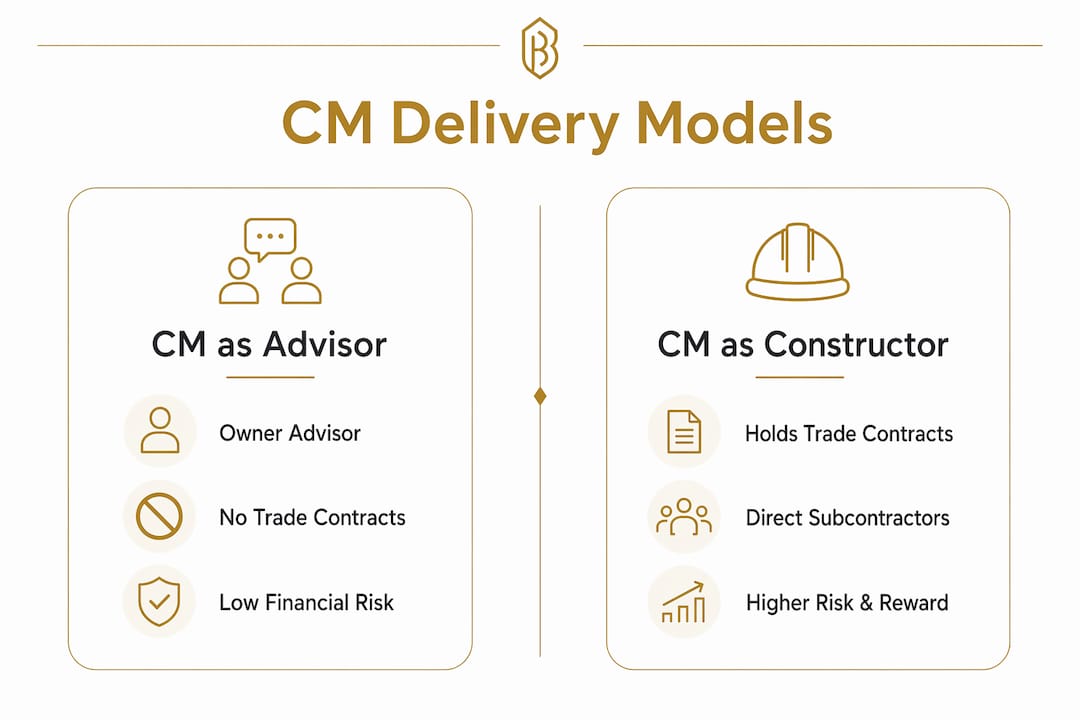
The choice of delivery model profoundly shapes the agreement’s risk allocation, payment structure, and the CM’s legal obligations. Three models dominate the industry, and each produces a materially different contract.
| Delivery Model | Who Holds Trade Contracts | CM’s Financial Risk | Typical Payment Structure |
|---|---|---|---|
| CM as Advisor (CMa) | Owner holds all trade contracts | None. CM is advisory only | Fixed fee or hourly rate |
| CM as Constructor (CMc) | CM holds subcontracts | Moderate. CM manages cost risk | Fee plus cost of work, often with GMP |
| CM at Risk (CMAR) | CM holds all subcontracts | High. CM commits to a Guaranteed Maximum Price | Cost of work plus fee, GMP cap |
CM as Advisor (CMa)
In the CMa model, the CM acts as an owner advisor without holding any construction contracts. The owner signs directly with each trade contractor, which increases the owner’s administrative workload but keeps the CM’s financial exposure at zero. This model suits owners with experienced in-house teams who want professional oversight without transferring contract management.
CM as Constructor (CMc)
The CMc model shifts trade contracts to the CM, who then manages subcontractors directly. This reduces the owner’s day-to-day administrative burden considerably. Agreements in this model frequently include a Guaranteed Maximum Price (GMP), which caps the owner’s cost exposure. If the CM delivers below the GMP, savings are typically shared according to a formula defined in the contract.
CM at Risk (CMAR)
CMAR agreements treat construction cost as cost of the work plus a fee with a GMP, and the CM assumes financial responsibility for any overrun above that cap. This is the most risk-intensive model for the CM and the most cost-predictable for the owner. Preconstruction services (estimating, constructability review, phasing planning) are often included as a separate phase before the GMP is formally established.
Pro Tip: CMAR works best on complex projects where early CM involvement in design can reduce costly surprises later. For straightforward builds, CMa often delivers the same oversight at lower total cost.
What key provisions are typically included in a construction management agreement?
Standard agreement templates from platforms like Rocket Lawyer and AIA Contract Documents share a consistent core structure. Each section addresses a specific risk or operational need.
The foundational provisions include:
- Project description: Defines the scope, location, and intended use of the project so both parties share the same understanding of what is being built.
- Scope of services: Lists every task the CM is responsible for, from preconstruction through closeout. Anything not listed is typically excluded.
- Compensation and payment terms: Specifies the fee structure (fixed fee, percentage of construction cost, or cost-plus), billing intervals, and conditions for additional compensation.
- Schedule: Sets milestone dates and defines what constitutes a delay attributable to the CM versus the owner or third parties.
- Liability and indemnification: Allocates responsibility for errors, omissions, and third-party claims between the owner and CM.
- Insurance requirements: Requires the CM to carry general liability, professional liability, and workers’ compensation coverage at specified limits.
- Termination provisions: Defines conditions under which either party may exit the agreement and the financial consequences of doing so.
- Dispute resolution: Specifies whether disputes go to mediation, arbitration, or litigation, and in which jurisdiction.
Insurance and bonding provisions are particularly consequential. They define financial responsibility when subcontractors default, when property is damaged, or when third-party claims arise. Owners who underspecify insurance requirements in the agreement often discover the gap only after an incident occurs.
How does a construction management agreement interface with permitting requirements?
Signed construction management agreements are not just internal documents. Many jurisdictions treat them as prerequisites for issuing building permits. The City of Minneapolis, for example, requires a signed agreement before residential construction can commence under its permit workflow. This requirement exists because regulators need a named, accountable party responsible for site safety and code compliance.
The practical sequence for most projects looks like this:
- Owner and CM negotiate and execute the construction management agreement.
- The signed agreement is submitted as part of the building permit application package.
- The permitting authority reviews the agreement to confirm the CM’s qualifications and scope.
- Permits are issued with the CM named as the responsible party for inspections.
- The CM coordinates all required inspections and maintains documentation for final certificate of occupancy.
Failing to execute the agreement before applying for permits delays the entire project timeline. In high-demand markets like Los Angeles, permit queues are long, and a missing document can push a project back by weeks. Contractor licensing and permit requirements vary by state and municipality, so verifying local requirements before drafting the agreement is non-negotiable.
The agreement also protects both parties legally during the permitting phase. If a regulatory agency issues a stop-work order or requests additional documentation, the agreement defines who is responsible for responding and within what timeframe. Owners who attempt to manage this process without a formal agreement often find themselves personally liable for compliance failures.
How can owners use these agreements to reduce risk and ensure project success?
The agreement is only as effective as the clarity of its terms. Vague language in scope-of-services clauses is the single most common source of construction management disputes. Owners who invest time in precise drafting recover that investment many times over in avoided conflicts.
Practical strategies for maximizing the agreement’s protective value include:
- Define the CM’s authority ceiling explicitly. Specify the maximum dollar amount the CM can commit without written owner approval.
- Negotiate a clear change order process. Require written documentation for every scope change before work begins, not after.
- Include a communication protocol. Specify how decisions are communicated, who has authority to approve them, and what response times are expected.
- Address design development milestones. In CMAR agreements, scope changes and late design development are the most common triggers for disputes. Tying the GMP to a defined design completion percentage reduces this risk.
- Review insurance certificates before work starts. Require updated certificates at each policy renewal period throughout the project.
Pro Tip: Hire a construction attorney to review the agreement before signing, even if you are using a standard AIA template. Template language is written to be neutral. An attorney can shift specific provisions to favor your position without disrupting the overall framework.
Amendments to the agreement should follow the same formal process as the original execution. Verbal agreements to change scope or fees are unenforceable in most jurisdictions and create exactly the ambiguity the written contract was designed to prevent.
Key takeaways
A construction management agreement defines the legal, financial, and operational relationship between the project owner and the CM, and selecting the right delivery model is the single most consequential decision an owner makes before breaking ground.
| Point | Details |
|---|---|
| Definition matters | A construction management agreement is a binding contract, not a letter of intent or informal arrangement. |
| Delivery model drives risk | CMa keeps risk with the owner; CMAR transfers cost risk to the CM under a GMP cap. |
| Authority clauses protect owners | Define dollar thresholds for CM commitments to prevent unauthorized financial exposure. |
| Permits require signed agreements | Many jurisdictions, including Minneapolis, require a signed agreement before issuing building permits. |
| Disputes cluster around scope changes | Documenting every change order in writing is the most effective way to protect the agreed-upon price. |
What I have learned after years of watching these agreements succeed and fail
After working through dozens of complex builds in Los Angeles, I have come to believe that most project failures trace back not to bad contractors but to bad contracts. Owners often treat the construction management agreement as a formality, something to sign quickly so the real work can begin. That instinct is understandable and consistently expensive.
The delivery model decision deserves far more deliberation than it typically receives. I have watched owners choose CMa because the fee looked lower, only to spend the next 18 months managing 14 separate trade contracts themselves. The advisory model is genuinely appropriate for owners with experienced project management staff. For everyone else, the apparent savings evaporate in administrative burden and coordination errors.
CMAR, on the other hand, is not a magic shield against cost overruns. The GMP only protects you if the design is sufficiently developed when the price is set. Owners who push for a GMP before design documents reach 60 to 70 percent completion are essentially asking the CM to price a moving target. The CM will protect themselves with contingencies, and the owner ends up paying for uncertainty anyway.
What actually works is specificity. The agreements I have seen perform best are the ones where both parties spent real time defining what “complete” means for every phase, what triggers a change order, and who has authority to approve what. That level of clarity feels tedious in negotiation and invaluable in execution.
— Daniel
How Builtblackbriar approaches construction management for luxury builds

Builtblackbriar brings the same contractual discipline described in this article to every luxury home project it manages in Los Angeles. The team works with clients to select the delivery model that matches their project’s complexity, whether that means a straightforward advisory arrangement or a full CMAR structure with a defined GMP. For technically demanding builds involving subterranean basements, cantilevered structures, or oversized glass installations, Builtblackbriar’s project management process includes detailed scope documentation, milestone-based communication protocols, and technology-driven progress reporting that keeps clients informed at every phase. Explore Builtblackbriar’s luxury home building services to see how structured construction management translates into on-time, on-budget project delivery for discerning homeowners and investors across Los Angeles.
FAQ
What is the difference between a construction management agreement and a general contractor contract?
A construction management agreement hires a CM to manage and coordinate a project on the owner’s behalf without performing physical construction work. A general contractor contract hires a single entity to both manage and build, typically under a lump-sum or fixed-price arrangement.
What does a construction manager do under this type of agreement?
The CM handles planning, budget tracking, schedule management, subcontractor coordination, design review, and regulatory compliance. The specific duties depend on whether the CM is engaged as an advisor or constructor under the agreement’s delivery model.
Is a signed construction management agreement required to get a building permit?
In many jurisdictions, yes. The City of Minneapolis, for example, requires a signed construction management agreement as part of its residential permit application process. Requirements vary by location, so verifying local rules before drafting the agreement is critical.
What is a Guaranteed Maximum Price in a construction management agreement?
A GMP is a contractual cost cap in CMc or CMAR agreements under which the construction manager assumes financial responsibility for any project costs that exceed the agreed maximum. It shifts cost risk from the owner to the CM.
How long does it take to negotiate a construction management agreement?
Negotiation timelines vary by project complexity, but most agreements for custom residential or mid-size commercial projects take two to six weeks to finalize. Engaging a construction attorney early in the process reduces back-and-forth and protects both parties’ interests from the start.