

June 11, 2026
What Is a High-End Construction Contract?

A high-end construction contract is a legally binding agreement specifically designed for luxury building projects, defining premium material specifications, advanced craftsmanship standards, complex cost structures, and risk allocations that standard residential contracts simply do not address. In the industry, these are often called premium construction agreements or luxury building contracts, and they govern projects that typically range from $2 million to well over $10 million depending on scope and finish level. The distinction matters because a generic contract leaves too many gaps when you are specifying Italian marble, custom steel windows, or a subterranean garage beneath a hillside lot in Los Angeles. Understanding what separates these agreements from standard contracts protects your investment, your timeline, and your relationship with your builder before the first shovel breaks ground.
What is a high-end construction contract, really?
A high-end construction contract is not simply a standard contract with a larger dollar amount attached. It is a purpose-built legal document that accounts for the specific risks, materials, and coordination demands of luxury construction. Premium projects typically range from $2M–$5M for high-spec homes, $5M–$8M for prestige estates, and $8M–$10M+ for ultra-luxury or heritage properties. Each tier introduces new layers of complexity that a boilerplate contract cannot manage.
These agreements cover several dimensions that standard contracts ignore entirely. They define the exact brand, model, and finish grade of every specified material. They set extended defect liability periods that reflect the scale of the investment. They include sophisticated change order protocols, because luxury builds evolve as clients refine their vision. They also establish insurance requirements, payment milestones tied to verified progress, and quality control checkpoints throughout the build.

The two most common delivery methods for high-end construction agreements are Cost-Plus and Guaranteed Maximum Price (GMP). Cost-Plus contracts bill actual project costs plus a contractor markup, while GMP contracts set a ceiling on total cost with the contractor absorbing overruns above that ceiling. Both structures appear frequently in luxury residential work, and choosing between them has real financial consequences. The right choice depends on how far along your design is, what your lender requires, and how much cost certainty you need before construction begins.
What premium terms distinguish luxury building contracts?
The defining feature of a luxury building contract is specificity. Premium contracts specify brand models, finishes, and quality grades rather than generic descriptions like “tile flooring” or “wood cabinetry.” This level of detail protects you from substitutions that look acceptable on paper but fall short in person.
Key provisions that set high-end construction agreements apart include:
- Material and fixture specifications: Every item is named by brand, model number, finish, and source. Imported stone, custom hardware, and specialty glazing systems each carry their own procurement timelines and quality standards.
- Extended defect liability periods: High-end contracts require extended defect liability periods to reflect the craftsmanship complexity and investment scale involved. Where a standard contract might offer a one-year warranty, a luxury agreement often extends coverage to two years or more on specific systems.
- Variation and change order management: Luxury builds evolve. A well-drafted contract defines a formal process for requesting, pricing, and approving changes before any work proceeds. This prevents disputes over cost and scope mid-project.
- Premium insurance requirements: Contracts specify coverage levels for builder’s risk insurance, public liability, and workers’ compensation that match the value of the project and its site-specific risks.
- Milestone-based payment schedules: Payments are tied to verified completion of defined stages, not arbitrary dates. This protects you from funding work that has not been completed to specification.
Pro Tip: Ask your attorney to review the defect liability clause before signing. Many standard-form contracts cap liability at a level far below the cost of repairing a failed waterproofing system or a structural defect in a custom foundation.
How do cost-plus and GMP contracts work in luxury builds?
The pricing structure of your contract determines how financial risk is shared between you and your builder. Cost-Plus contracts bill actual costs plus a markup typically ranging from 15–25%, while GMP contracts cap total costs with the contractor absorbing overruns above the ceiling. Understanding both structures is non-negotiable for anyone managing a high-value construction project.
| Feature | Cost-Plus | GMP |
|---|---|---|
| Price certainty | Low: final cost is unknown until completion | High: maximum cost is fixed at contract signing |
| Transparency | High: all costs are open-book | Moderate: costs visible up to the ceiling |
| Risk allocation | Owner bears cost overrun risk | Contractor bears overrun risk above the ceiling |
| Best suited for | Early-stage or highly custom designs | Projects at 80%+ design completion |
| Lender acceptance | Often rejected without a budget cap | Preferred by sophisticated lenders |
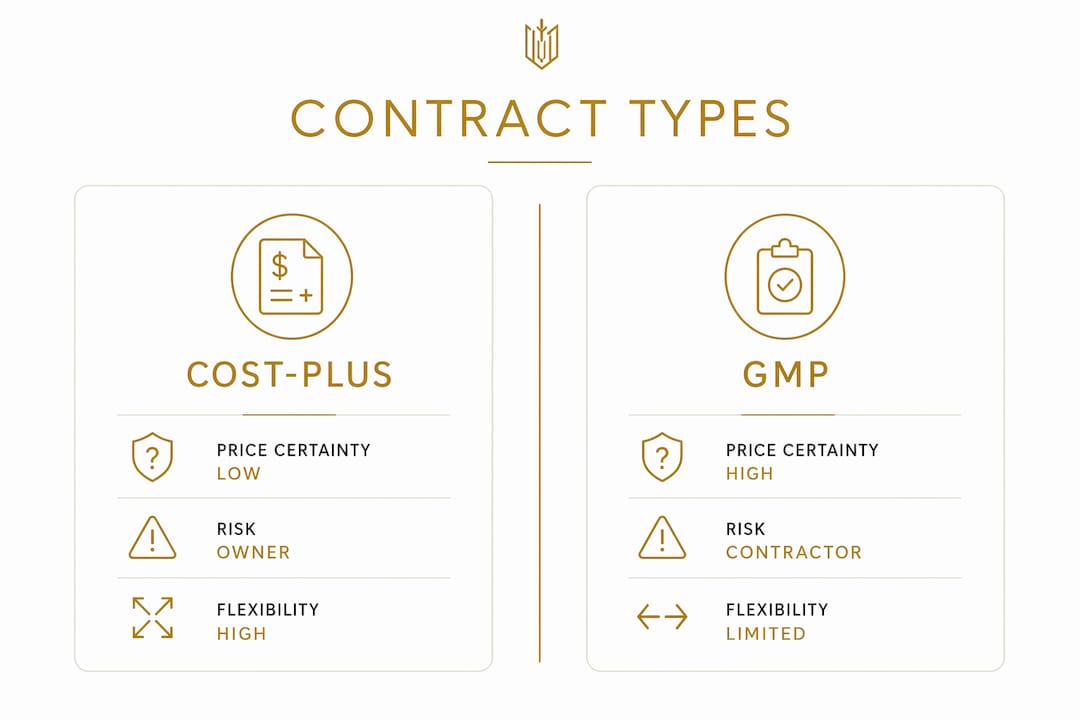
GMP contracts dominate luxury and multi-unit projects, accounting for 60–70% of high-end builds. That dominance reflects a practical reality: owners and lenders both want a ceiling on exposure before committing to a multi-million-dollar build. Cost-Plus contracts offer more flexibility during early design phases, but they transfer financial risk entirely to the owner.
Luxury projects often evolve from Cost-Plus to GMP as design nears 80% completion, shifting risk allocation and establishing the budget certainty that lenders require. This transition is not automatic. It requires a contractor who has tracked costs carefully during the Cost-Plus phase and can price a GMP ceiling with confidence. Sophisticated lenders often require GMP at advanced design stages to cap their financial exposure, and projects that cannot demonstrate a credible ceiling may face financing delays.
One risk with GMP contracts deserves attention. Signing a GMP before design is complete creates ambiguous scope, and “reasonably inferable” clauses can expand contractor obligations beyond original pricing assumptions. This leads to disputes over who pays for work that was implied but never explicitly defined.
Pro Tip: Never sign a GMP contract with less than 80% design completion. The savings in schedule time are not worth the disputes that arise when scope gaps surface during construction.
Why does early contractor involvement matter?
Early contractor involvement is the single most effective way to reduce cost surprises in a luxury build. Engaging a general contractor during pre-construction and design phases reduces change orders, improves overhead structure planning, and aligns expectations before the contract is finalized. Builders like those at Beverly Hills luxury projects consistently demonstrate that early involvement prevents the costly scope changes that derail timelines and budgets.
The practical benefits of bringing your contractor in early include:
- Realistic cost modeling: Your contractor can identify procurement lead times for specialty materials, flag constructability issues in the design, and build a cost model that reflects actual market conditions rather than theoretical estimates.
- Scope clarity before contract signing: Ambiguities in the design documents become expensive disputes after signing. Early involvement surfaces these gaps while they are still cheap to resolve.
- Stronger lender relationships: Lenders often reject Cost-Plus contracts lacking budget caps, and projects that engage a contractor early can transition to GMP with a credible cost basis that satisfies institutional requirements.
- Trust and communication: A contractor who has been part of the design conversation understands the owner’s priorities. That shared context reduces friction when decisions need to be made quickly during construction.
The Fratantoni Luxury Estates model, documented in their custom home builder contracts guidance, endorses early general contractor involvement as a best practice specifically because it prevents the cascade of change orders that inflate costs and erode trust on luxury projects.
What best practices protect you in premium contract negotiations?
Managing a high-value construction project requires more than a well-drafted contract. It requires a disciplined approach to documentation, communication, and risk management from the first design meeting through final punch list.
-
Document every specification in full. Generic descriptions create substitution risk. Every material, fixture, and finish should be identified by brand, model, and grade. Well-structured contracts clearly define scope, payment schedules, warranties, change orders, and dispute resolution to provide legal protection and risk management for high-end renovations and new builds alike.
-
Tie payments to verified milestones. Payment schedules based on calendar dates rather than construction progress create leverage imbalances. Milestone-based schedules keep financial incentives aligned with actual performance.
-
Include a robust dispute resolution clause. Luxury projects are complex, and disagreements arise. A tiered dispute resolution process (negotiation, then mediation, then arbitration) resolves conflicts faster and at lower cost than litigation.
-
Adopt GMP at the right design milestone. Converting from Cost-Plus to GMP at 80% design completion gives you budget certainty without locking in a ceiling before the scope is defined. This timing also satisfies most lender requirements.
-
Require lien waivers at each payment milestone. Lien waivers from your general contractor and all major subcontractors protect your property from mechanics’ liens filed by parties your GC has not paid.
Pro Tip: Request a schedule of values with your first payment application. This document breaks the contract sum into line items and makes it far easier to verify that progress matches the payment request.
Key takeaways
A high-end construction contract protects your investment by defining premium specifications, allocating financial risk through Cost-Plus or GMP structures, and establishing the legal framework for quality, payment, and dispute resolution across the full project lifecycle.
| Point | Details |
|---|---|
| Specificity defines luxury contracts | Name every material by brand, model, and grade to prevent substitutions. |
| GMP dominates high-end builds | GMP contracts cover 60–70% of luxury projects, providing the budget ceiling lenders require. |
| Design completion drives contract timing | Convert from Cost-Plus to GMP at 80% design completion to lock in scope and cost certainty. |
| Early contractor involvement reduces risk | Bringing your GC into pre-construction cuts change orders and aligns cost models with reality. |
| Milestone payments protect both parties | Tie every payment to verified construction progress, not calendar dates. |
What i have learned about contracts after years in luxury construction
The most common mistake I see owners make is treating the contract as a formality rather than a management tool. A luxury building contract is the clearest expression of what you and your builder have agreed to build, at what cost, and to what standard. When that document is vague, every ambiguity becomes a negotiation under pressure, and pressure during construction is expensive.
The shift from Cost-Plus to GMP is where I see the most friction. Owners want budget certainty early. Contractors want design clarity before committing to a ceiling. Both positions are reasonable. The solution is not to force a GMP before the design is ready. The solution is to invest in getting the design to 80% completion before you ask your contractor to price a ceiling. That investment pays for itself many times over in avoided disputes.
I also think the industry undervalues extended defect liability periods. A luxury home is not just a building. It is a long-term asset, and the craftsmanship that defines it should be backed by a warranty that reflects its complexity. When you are specifying custom steel windows, photovoltaic panel systems, or subterranean waterproofing, a one-year warranty is not adequate protection. Push for two years minimum on specialty systems, and make sure the contract names the systems covered explicitly.
The contracts that work best are the ones that feel almost unnecessary during construction because every decision was made in advance. That is the goal: a document so complete that the project runs on the logic of the agreement rather than the judgment of whoever is on site that day.
— Daniel
How Builtblackbriar approaches luxury contract management
Builtblackbriar specializes in exactly the kind of complex, high-specification builds where contract clarity is not optional. From subterranean basements to oversized glass installations across Los Angeles, the team brings contractors into the design process early, tracks costs transparently, and structures agreements that protect clients at every phase.

If you are planning a luxury home build in Los Angeles and want a builder who treats the contract as a foundation for collaboration rather than a legal formality, Builtblackbriar is built for that conversation. Explore Builtblackbriar’s luxury construction services to see how transparent contract management and early involvement translate into on-time, on-budget project completions for discerning homeowners and investors.
FAQ
What is a high-end construction contract?
A high-end construction contract is a legally binding agreement for luxury building projects exceeding $2 million, specifying premium materials by brand and grade, extended warranties, milestone-based payments, and detailed risk allocations that standard contracts do not include.
What is the difference between cost-plus and GMP contracts?
Cost-Plus contracts bill actual costs plus a contractor markup of 15–25%, while GMP contracts set a fixed ceiling with the contractor absorbing overruns. GMP dominates luxury builds at 60–70% of projects because it provides the budget certainty that lenders and owners require.
When should a luxury project switch from cost-plus to GMP?
Projects typically convert from Cost-Plus to GMP when design reaches approximately 80% completion. Converting earlier risks locking in a ceiling before scope is fully defined, which creates disputes over undefined work.
Why do lenders prefer GMP contracts for high-value projects?
Sophisticated lenders often reject Cost-Plus contracts because they lack a budget ceiling. GMP contracts cap financial exposure, giving lenders the certainty they need to approve financing for high-value developments.
What should every luxury building contract include?
Every luxury building contract should include named material specifications, milestone-based payment schedules, extended defect liability periods, a formal change order process, robust dispute resolution clauses, and lien waiver requirements at each payment stage.