

June 7, 2026
What Is a Luxury Builder Selection Process?

The luxury builder selection process is a structured, multi-phase evaluation that high net worth homeowners use to identify, vet, and contract a custom home builder whose technical capabilities, operational discipline, and communication style align with the demands of an architecturally significant project. This is not a vendor search. It is the foundation of a working partnership that will govern every decision made across an 18-month project cycle, from the first schematic sketch to the final walkthrough. Getting this process right protects your investment, your timeline, and your vision. Getting it wrong costs far more than money.
What is the luxury builder selection process, step by step?
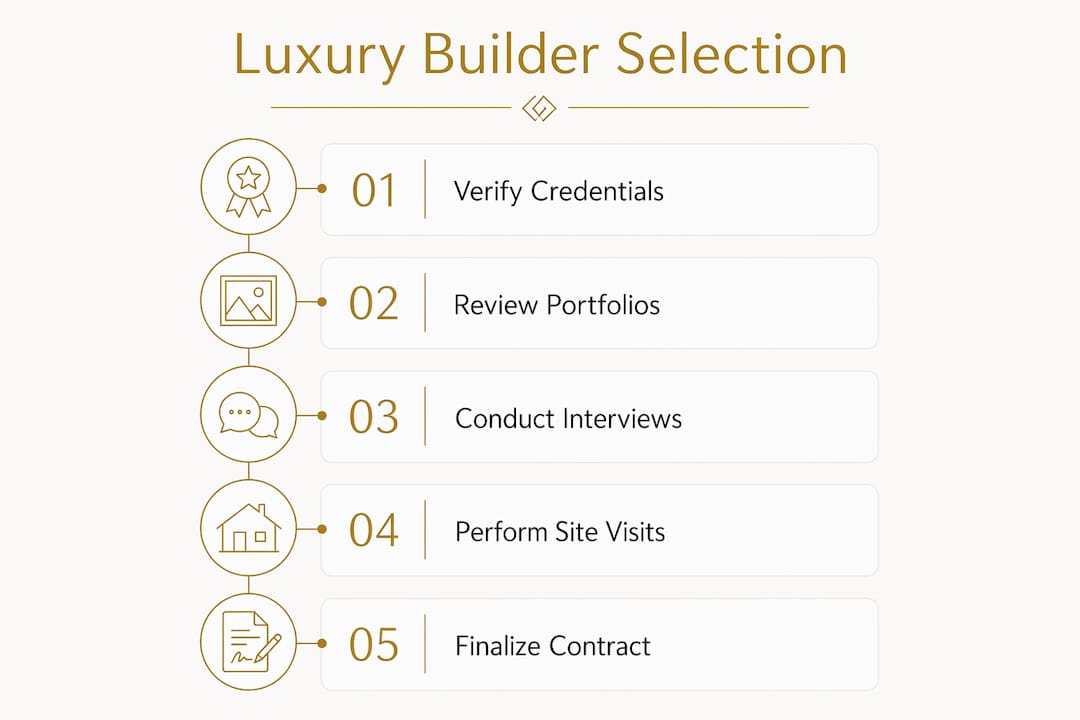
The selection process follows a clear sequence, and skipping any phase introduces compounding risk. Think of it as a funnel: you begin with a broad field of candidates and progressively narrow based on evidence, not instinct.
-
Initial research and credential verification. Confirm active licenses, general liability insurance, and workers’ compensation coverage. Request proof of financial stability, including bonding capacity. A builder who hesitates here is a builder who has something to hide.
-
Portfolio review with a critical eye. Examine completed projects for complexity comparable to yours. Subterranean basements, cantilevered structures, and large-format glass installations require specialized subcontractor networks and engineering coordination that most builders simply do not have. Portfolio photos are marketing. Ask for structural drawings and permit histories instead.
-
Shortlisting and structured interviews. Reduce your field to three to five candidates and conduct formal interviews. Focus on how they communicate, not just what they say. Ask how they handle scope changes, budget overruns, and design conflicts. Their answers reveal their systems, or the absence of them.
-
Site visits to active and completed projects. An active construction site tells you more than a finished home ever will. Look at material storage, safety protocols, and crew organization. Disorder on site predicts disorder in your project.
-
Post-build support and warranty review. Luxury construction does not end at handover. Evaluate the builder’s warranty terms, response time commitments, and track record for addressing post-occupancy issues.
-
Contract review. The final contract must define payment schedules, change order procedures, and dispute resolution mechanisms in explicit written terms. Luxury projects involve 1,500 to 3,000 or more individual decisions, and every one of them needs a documented path for resolution.
Pro Tip: Ask each candidate to walk you through a real change order from a past project, including how the cost was calculated and how the client was notified. This single exercise separates builders with genuine systems from those who improvise.
How does the design-build approach affect builder selection?

The design-build model consolidates architectural design and construction management under one contract and one point of accountability. This is fundamentally different from the traditional design-bid-build model, where an architect produces drawings and then separate contractors bid on the work.
In design-bid-build, the architect and builder are separate entities with separate incentives. Conflicts between design intent and construction feasibility are common, and the homeowner often becomes the mediator. In design-build, the same firm owns both the vision and the execution, which eliminates that friction, provided the firm has genuine depth in both disciplines.
The selection criteria shift accordingly. When evaluating a design-build firm, you are assessing an integrated team rather than a single trade. Design-build accountability requires clear ownership of documentation and cost feedback loops to prevent gaps where no one is responsible for a decision. Ask specifically who owns the construction documents, who approves cost implications of design changes, and what happens when the two sides of the firm disagree.
- Verify that the firm employs licensed architects, not just designers with aesthetic credentials.
- Request examples of constructability reviews conducted during the design phase.
- Confirm that budget alignment meetings occur at each design milestone, not just at the end.
- Review how the firm handles value engineering requests without compromising design integrity.
Pro Tip: Request a sample design-build contract before signing anything. The contract structure reveals whether accountability is genuinely integrated or whether the firm is simply marketing two services under one roof.
The 4-to-6-month design phase is where most budget and schedule problems are either prevented or created. A design-build firm that rushes this phase to start construction sooner is prioritizing cash flow over your project’s success.
What criteria should you prioritize when evaluating luxury home builders?
Beyond aesthetics and reputation, the evaluation of a luxury builder rests on three pillars: operational transparency, financial health, and interpersonal fit.
Operational transparency is the most reliable predictor of project success. Builders with strong transparency systems provide real-time job costing, labor tracking, and centralized project communication. This means you can see where your money is going at any point in the project, not just at billing intervals. Ask candidates to demonstrate their project management platform. If they use spreadsheets and email threads, that is your answer.
Financial health matters because an undercapitalized builder creates risk for your project. If a builder overextends across multiple projects simultaneously, your job may be deprioritized when cash flow tightens. Request recent financial statements or, at minimum, a letter from their bonding company confirming current bonding capacity.
Interpersonal fit is not soft criteria. Clients should expect a collaborative relationship lasting 12 to 18 months or longer, making communication style as important as technical credentials. A builder who is technically excellent but dismissive of client input will make your project miserable.
| Evaluation Criterion | What to Look For | Red Flag |
|---|---|---|
| Licensing and insurance | Active license, full coverage, bonding capacity | Expired documents or reluctance to share |
| Operational transparency | Real-time job costing, project management platform | Verbal-only updates, no written systems |
| Portfolio relevance | Projects matching your complexity and scale | Only residential renovations, no custom builds |
| Financial stability | Bonding letter, no liens on past projects | Undisclosed financial obligations |
| Communication style | Structured updates, clear escalation paths | Vague timelines, reactive rather than proactive |
Selecting a luxury builder is a risk-management exercise as much as a creative one. The builders who thrive in this segment are those who have built systems to manage complexity, not just the talent to design beautiful spaces.
How to conduct effective interviews and site visits
The interview is where you test the systems a builder claims to have. Prepare specific, scenario-based questions rather than open-ended prompts. Generic questions produce polished, rehearsed answers that tell you nothing.
Questions that reveal genuine operational depth include: How do you communicate budget impacts when a client requests a design change mid-construction? Describe a project where a subcontractor failed to perform. What happened, and how did you resolve it? What does your weekly client communication look like, and who is responsible for it?
During site visits, shift your attention from finishes to process. Visiting active construction sites reveals operational discipline more accurately than touring finished homes. Observe whether materials are stored properly to prevent damage, whether safety signage is current, and whether the site superintendent can answer questions about the project schedule without consulting the builder principal.
- Ask to speak with the project manager, not just the principal or sales representative.
- Request contact information for three past clients and call all three, not just the ones who respond first.
- Ask past clients specifically about how the builder handled problems, not just whether they were satisfied overall.
Blind scoring using weighted rubrics mitigates anchoring bias during the selection process. Score each candidate independently on criteria like communication, systems, portfolio relevance, and financial stability before comparing scores across candidates. This prevents the first impressive builder you meet from skewing your perception of everyone who follows.
Common mistakes and expert tips for a successful selection
The most costly mistake in the luxury builder selection process is choosing based on price or personal referral without independent verification. Selecting a builder on lowest bid ignores financial health and complex project experience. A low bid often signals an undercapitalized firm, an incomplete scope, or a builder who plans to recover margin through change orders.
Friend-of-a-friend recommendations carry a different risk. Social relationships create pressure to overlook red flags that would otherwise disqualify a candidate. The builder who did a beautiful kitchen renovation for your neighbor may have no experience managing a 6,000-square-foot custom build with a subterranean garage and photovoltaic panel integration.
Incomplete contracts are the second most common failure point. Vague language around change orders, allowances, and schedule milestones creates disputes that are expensive and emotionally draining to resolve. Every line item in the contract should have a defined process for modification, approval, and cost documentation.
“The builders who consistently deliver on luxury projects are the ones who treat documentation as a discipline, not a burden. Written systems protect the client and the builder equally.”
Pro Tip: Before signing a contract, ask your attorney or a construction consultant to review the change order clause specifically. This single provision governs more disputes than any other section of a luxury construction agreement.
Early architectural and construction integration during the design phase protects both the home’s vision and the budget. Builders who participate in design reviews before construction documents are finalized catch constructability problems while they are still inexpensive to fix. This is a hallmark of operationally mature firms.
Key takeaways
The luxury builder selection process succeeds when it treats operational transparency, financial stability, and communication fit as non-negotiable criteria alongside technical skill and portfolio quality.
| Point | Details |
|---|---|
| Start with credentials, not aesthetics | Verify licenses, insurance, and bonding capacity before reviewing a single portfolio image. |
| Operational transparency predicts success | Builders with real-time job costing and centralized communication platforms deliver more predictable outcomes. |
| Design-build requires integrated accountability | Confirm clear ownership of documentation and cost feedback loops before signing a design-build contract. |
| Interviews should be scenario-based | Ask how builders handled real problems, not how they would handle hypothetical ones. |
| Blind scoring reduces selection bias | Score candidates independently on weighted criteria before comparing them to avoid anchoring on first impressions. |
Why builder selection is the most consequential decision you will make
I have worked alongside luxury home projects in Los Angeles long enough to recognize a pattern: the projects that finish on time and on budget almost always trace their success back to one decision made before a single permit was filed. The builder selection.
What I have observed consistently is that operational transparency is the single most reliable predictor of project success. Not the builder’s Instagram portfolio. Not the awards on their website. The question I always ask is: can this builder show me, in real time, where my money is going? If the answer involves a spreadsheet and a phone call, that is not a transparency system. That is a workaround.
The personality fit matters more than most clients expect. You will spend 12 to 18 months in close collaboration with this person and their team. Disagreements will happen. Design changes will happen. The question is not whether problems will arise. It is whether your builder has the communication discipline and the personal integrity to navigate them with you rather than around you.
My honest advice: weight the interview and site visit phase more heavily than the portfolio review. Beautiful finished homes are the product of good subcontractors as much as good builders. An organized, well-run active construction site is the product of the builder alone.
— Daniel
How Builtblackbriar supports your builder selection journey
Builtblackbriar brings deep operational knowledge to every stage of the luxury home builder process in Los Angeles, from initial credential verification to final contract review.

Builtblackbriar specializes in complex builds, including subterranean basements and large-format glass installations, across high-demand Los Angeles neighborhoods. Their technology-integrated approach means clients receive structured updates and documented communication throughout every phase, not just at billing milestones. For homeowners in areas like Brentwood and Calabasas, Builtblackbriar offers vetted builder guidance and project management support built specifically for discerning clients who expect both craftsmanship and accountability. Contact Builtblackbriar to begin your selection process with a team that has already done the vetting work for you.
FAQ
What is the luxury builder selection process?
The luxury builder selection process is a structured evaluation covering credential verification, portfolio review, interviews, site visits, and contract analysis to identify a custom home builder whose operational systems and communication style match the demands of a high-end project.
How long does the luxury builder selection process take?
The selection process typically takes four to eight weeks when conducted thoroughly. Rushing it to save time is one of the most common and costly mistakes in custom home construction.
What is the most important criterion when selecting a luxury builder?
Operational transparency, specifically the builder’s use of real-time job costing and centralized project management, is the most reliable indicator of whether a luxury project will finish on time and within budget.
Should I choose a design-build firm or a traditional builder?
Design-build firms offer integrated accountability between design and construction, which reduces conflicts and communication gaps. The key is confirming that the firm has genuine depth in both disciplines and clear documentation ownership across both phases.
What are the biggest red flags during builder interviews?
Reluctance to share financial documents, verbal-only communication systems, and vague change order processes are the three most significant red flags. A builder who cannot explain their change order procedure in specific terms has not built a system for managing it.