

June 14, 2026
What Is a Punch List in Construction?

A punch list in construction is a formal document identifying incomplete or defective work items that must be corrected before a project reaches final acceptance and full payment is released. Known in the industry as a “closeout checklist” or “deficiency list,” this document is prepared near substantial completion and names each item, the responsible party, the due date, and the current status. Owners, general contractors, architects, and subcontractors all interact with it. For homeowners and project managers alike, understanding what a punch list is and how it works is the difference between a clean project closeout and months of unresolved disputes.
What is a punch list in construction and why does it matter?
A construction punch list is defined as a written record of unfinished or non-conforming work discovered during a final walkthrough inspection. The term “punch” traces back to the practice of physically punching a hole next to each item on a paper list once it was completed. Today the format has changed, but the purpose has not: drive the project to zero outstanding items so ownership can transfer cleanly.
The document matters because it creates legal and financial accountability. Without a formal punch list, contractors and owners often disagree on what “done” actually means. That ambiguity delays final payment, triggers warranty disputes, and sometimes ends in litigation. A punch list removes the gray area by putting every outstanding item in writing, assigning it to a named party, and setting a deadline.

Punch lists are also control points for construction quality assurance. They are not informal notes passed between a homeowner and a site supervisor. They are contractual documents that define the boundary between substantial completion (when the project is usable) and final completion (when every obligation is met).
What items typically appear on a punch list?
Punch list items are typically minor corrections, cosmetic defects, and incomplete tasks discovered at the end of a project. They are not major scope changes. Any work that falls outside the original contract requires a separate change order, not a punch list entry.
Common punch list items examples include:
- Paint touch-ups: scuffs, missed corners, or uneven coverage on walls and trim
- Hardware and fixtures: cabinet pulls installed at the wrong height, towel bars not level, or missing escutcheon plates
- Appliance testing: confirming that dishwashers, range hoods, and HVAC systems operate per manufacturer specs
- Door and window adjustments: doors that drag, windows that don’t latch, or weatherstripping gaps
- Ductwork and mechanical: exposed duct sections that need insulation or grilles that are missing
- Flooring: scratches on hardwood, grout gaps in tile, or carpet seams that have lifted
- Exterior work: caulking around windows, missing downspout extensions, or landscaping items specified in the contract
The distinction between a punch list item and a change order is critical. If a homeowner decides mid-closeout that they want a different tile pattern, that is a change order. If the tile installer left a cracked tile that was specified in the contract, that is a punch list item. Keeping this boundary clear prevents scope creep and protects both parties.
Pro Tip: Write each punch list item as a measurable defect tied to a contract specification. “Paint touch-up needed in master bedroom at east wall, 18 inches from door frame” is enforceable. “Paint looks bad” is not.
How is a punch list created and managed?
The punch list process begins at the substantial completion milestone, when the project is far enough along that the owner can occupy or use the space. At this point, the general contractor, owner, and architect (or owner’s representative) conduct a formal walkthrough inspection together.
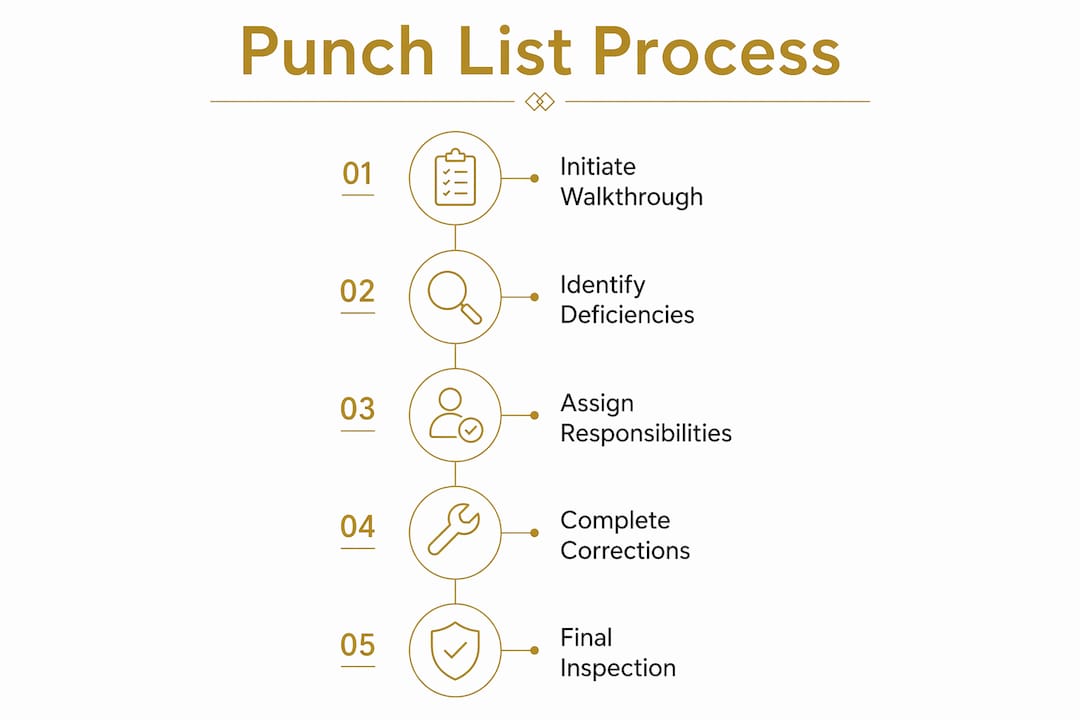
Here is how the process typically unfolds on a well-run project:
- Schedule the walkthrough. The general contractor notifies all parties when substantial completion is reached and sets a walkthrough date. All relevant subcontractors should be available or on call.
- Conduct the inspection. Each area of the project is reviewed against the contract drawings and specifications. Every deficiency is documented with a description, location, and photo where possible.
- Assign items. Each punch list entry is assigned to the responsible trade or subcontractor, with a realistic due date attached.
- Track progress. The general contractor updates item status as corrections are completed. Owners or architects verify completed items before marking them closed.
- Conduct a re-inspection. Once the contractor reports all items resolved, a final walkthrough confirms closure. Any items still open restart the cycle.
Digital tools have replaced paper binders on most professional job sites. Platforms like Procore, PlanGrid (now part of Autodesk Construction Cloud), and Fieldwire allow teams to log items, attach photos, assign trades, and track status in real time. For smaller residential projects, a well-structured spreadsheet or a template from TeamGantt serves the same purpose.
| Phase | Action | Responsible Party |
|---|---|---|
| Substantial Completion | Initiate walkthrough and document deficiencies | GC, Owner, Architect |
| Item Assignment | Assign each item to a trade with a due date | General Contractor |
| Correction Period | Complete repairs and corrections | Subcontractors |
| Verification | Confirm each item is resolved | Owner or Architect |
| Final Sign-Off | Close the punch list and release retainage | All Parties |
A rolling punch list is a practice where deficiencies are logged throughout construction rather than only at the end. On larger projects, this approach dramatically reduces the volume of items discovered at closeout. It distributes the correction workload across the build schedule instead of compressing it into the final weeks.
Pro Tip: On any project over $500,000, start a rolling punch list at the 50% completion mark. Catching a misaligned window frame during framing costs far less to fix than catching it after drywall, paint, and trim are installed.
What is the legal role of a punch list in construction contracts?
The punch list sits at the intersection of two critical contract milestones: substantial completion and final completion. Substantial completion is the legal milestone at which the project is sufficiently complete for its intended use, even though minor items remain. Final completion occurs when every punch list item is resolved and all contract obligations are fulfilled.
This distinction has direct financial consequences. Most construction contracts, including those written under AIA A201 General Conditions (the American Institute of Architects’ standard contract form), tie retainage release to punch list completion. Retainage is a percentage of each payment (commonly 5–10%) that the owner withholds until the project is complete. The punch list is the mechanism that defines when “complete” actually happens.
“Substantial completion is the stage in the progress of the work when the work or designated portion thereof is sufficiently complete in accordance with the contract documents so that the owner can occupy or utilize the work for its intended use.” — AIA A201
Key legal considerations include:
- Formal sign-off matters. A verbal agreement that “everything looks good” is not a substitute for a signed punch list closeout document. Verbal sign-offs leave both parties exposed to disputes months later.
- Punch lists are not change vehicles. Items outside the contract cannot be added to a punch list without a change order. Attempting to do so creates scope creep and can void the contractor’s right to final payment.
- Warranty periods often start at substantial completion. Knowing this date precisely matters for both owners and contractors when warranty claims arise later.
- Retainage disputes are common. If punch list items are not clearly documented and formally closed, contractors may face delayed final payment even after completing all work.
Best practices for homeowners and project managers
Effective punch list management is a skill, not a formality. The following practices separate projects that close cleanly from those that drag on for months.
Write clear, measurable item descriptions. Vague entries like “fix bathroom” create arguments. Specific entries like “re-caulk tub surround at south wall, gap exceeds 1/8 inch per spec section 07 92 00” are unambiguous. Tie every item to a contract specification or drawing reference where possible.
Bring contract documents to the walkthrough. The punch list is only as good as the standard it references. Walking a project without the contract drawings and specifications means you are relying on memory rather than the agreed scope. Architects and experienced project managers always carry the full document set.
Assign responsibilities fairly and specifically. Each item should name the responsible subcontractor, not just the general contractor. This prevents the GC from becoming a bottleneck and gives trades direct ownership of their corrections.
Use technology to track status. A construction project management workflow that integrates punch list tracking eliminates the version-control problems that plague paper lists. When an item is marked complete in a shared platform, everyone sees it instantly.
Set a firm re-inspection date. Open-ended punch lists tend to stay open. Set a specific date for the re-inspection when you assign items. This creates urgency and gives subcontractors a clear target.
| Approach | Outcome |
|---|---|
| Vague item descriptions | Disputes over what “fixed” means |
| Specific, spec-referenced descriptions | Clear acceptance criteria, faster closure |
| Paper-based tracking | Version confusion, lost items |
| Digital platform tracking | Real-time status, full audit trail |
| Verbal sign-off only | Payment and warranty disputes |
| Formal written sign-off | Clean legal closeout, retainage released |
Pro Tip: A construction project management checklist used throughout the build gives you a head start on punch list content. Many items that appear at closeout were visible earlier but never formally logged.
A well-run walkthrough with formal sign-off documentation protects both the homeowner and the contractor. It establishes a clear record of what was corrected, when, and by whom. That record becomes invaluable if a warranty claim surfaces six months after move-in.
Key takeaways
A punch list is the formal mechanism that converts a substantially complete project into a fully accepted one, protecting both payment and quality.
| Point | Details |
|---|---|
| Core definition | A punch list documents incomplete or defective work items requiring correction before final project acceptance. |
| Timing matters | Punch lists are initiated at substantial completion, the legal milestone when the project becomes usable. |
| Legal and financial weight | Retainage release and final payment are tied directly to punch list completion under contracts like AIA A201. |
| Rolling punch lists reduce risk | Logging deficiencies throughout construction shrinks the closeout workload and lowers correction costs. |
| Formal sign-off is non-negotiable | Written, signed closeout documentation prevents payment disputes and protects warranty rights for both parties. |
What i’ve learned about punch lists after years on complex builds
The most common mistake I see on residential projects is treating the punch list as an afterthought. Teams rush to get to substantial completion, then scramble to document everything at once. The result is a bloated list, overwhelmed subcontractors, and a closeout that drags weeks past the planned date.
The projects that close cleanly share one habit: they start documenting deficiencies early. On a complex build, whether that involves subterranean basement waterproofing details or oversized glass curtain wall systems, the number of potential punch list items is simply too large to catch in a single walkthrough. Starting a rolling log at the 50% mark means the final walkthrough is a confirmation, not a discovery session.
I also think the industry underestimates how much clear writing matters. A punch list item that reads “check window” will sit open indefinitely because no one agrees on what “checked” means. An item that reads “verify operable sash on unit 3A operates within 10-pound force per AAMA 101 spec” gets resolved in one visit. Precision in language is not bureaucracy. It is respect for everyone’s time.
Finally, homeowners deserve to be active participants in the punch list process, not passive observers. You are the one who will live in the space. Walk every room. Open every door. Run every faucet. The punch list is your last formal opportunity to hold the project to the standard you paid for.
— Daniel
How Builtblackbriar handles project closeout
At Builtblackbriar, the punch list process is built into every project from the start, not added at the end. The team’s approach to luxury home construction in Los Angeles includes rolling deficiency tracking, digital status updates shared with clients in real time, and formal sign-off procedures that protect both the homeowner and the build team.

Clients working on complex builds, from subterranean basements to large-scale glass installations, benefit from a closeout process that leaves nothing to chance. Every item is documented, assigned, verified, and formally closed before final payment is requested. If you are planning a high-end build in Los Angeles and want a team that treats the punch list as a quality commitment rather than a formality, start the conversation with Builtblackbriar today.
FAQ
What is a punch list in construction?
A punch list is a formal document listing incomplete or defective work items that must be corrected before a construction project reaches final acceptance and full payment is released. It is prepared near substantial completion and assigns each item to a responsible party with a due date.
What are common punch list items examples?
Common items include paint touch-ups, misaligned hardware, appliance testing, door and window adjustments, exposed ductwork, flooring defects, and exterior caulking gaps. All items must relate to work specified in the original contract.
How does a punch list affect final payment?
Punch list completion is directly tied to retainage release and final payment under most construction contracts, including those written under AIA A201 General Conditions. The contractor receives the withheld retainage only after all punch list items are formally closed and signed off.
What is the difference between substantial and final completion?
Substantial completion is the point when the project is usable for its intended purpose, even if minor items remain. Final completion occurs when every punch list item is resolved and all contract obligations are fully met.
Can a homeowner add new requests to the punch list?
No. A punch list covers only work that is incomplete or defective relative to the original contract. New requests or design changes require a separate change order and cannot be added to the punch list without the contractor’s agreement.