

May 18, 2026
What Is Commercial Construction Explained Simply
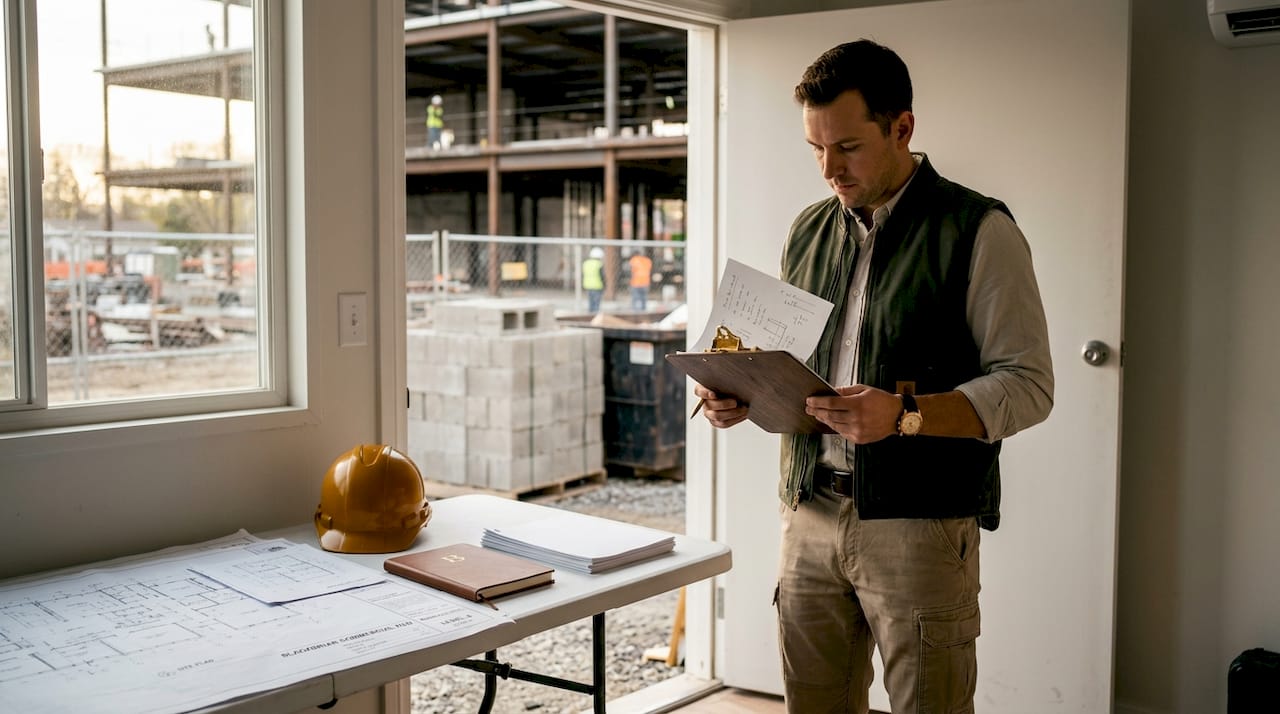
Commercial construction is one of those terms that sounds self-explanatory until you actually need to understand it. Most people assume it just means building big. In reality, what is commercial construction explained properly involves a distinct set of project types, regulatory frameworks, procurement methods, and cost structures that differ substantially from anything in the residential world. The US commercial construction industry generates roughly $745.6 billion in annual revenue across 39,100 establishments, and that scale reflects just how much economic activity depends on getting these projects right. Whether you are planning an investment, evaluating a development opportunity, or simply trying to speak the language, this guide gives you the full picture.
Table of Contents
- Key takeaways
- Types of commercial construction projects
- The commercial construction process
- Understanding costs in commercial construction
- Regulatory and code requirements
- My perspective on navigating commercial projects
- How Builtblackbriar approaches complex builds
- FAQ
Key takeaways
| Point | Details |
|---|---|
| More than just big buildings | Commercial construction covers offices, healthcare, retail, hospitality, and mixed-use projects of all sizes. |
| Process complexity matters | Five distinct phases govern commercial projects, and skipping steps creates costly delays and disputes. |
| Hard vs. soft costs | Hard costs cover 70-80% of budgets; underestimating soft costs is the most common budgeting mistake. |
| Code compliance is non-negotiable | The International Building Code applies in 49 states and governs occupancy, fire resistance, and accessibility. |
| Early contractor involvement pays off | Bringing your general contractor in during schematic design can compress schedules by 15-25%. |
Types of commercial construction projects
The phrase “commercial building” covers far more ground than most people expect. At its core, a commercial construction project is any build intended for business, institutional, or public use rather than private residential occupancy. That definition pulls in an enormous range of project types.
Common categories include:
- Office buildings (from single-tenant low-rise to multi-story corporate campuses)
- Retail centers (strip malls, big-box stores, shopping centers)
- Healthcare facilities (clinics, medical office buildings, hospitals)
- Hospitality (hotels, resorts, extended-stay properties)
- Warehouses and logistics centers (distribution hubs, cold storage, fulfillment facilities)
- Mixed-use developments (ground-floor retail with residential or office above)
- Educational and institutional buildings (schools, libraries, government offices)
The commercial construction market is projected to reach $723.25 billion by 2031 at a compound annual growth rate of 4.22%, driven largely by logistics infrastructure, data centers, and public building retrofits. That growth trajectory tells you something important: the types of projects in demand are shifting, and understanding which category your project falls into shapes everything from permitting to financing.
Here is how commercial construction compares to the two sectors most often confused with it:
| Category | Primary use | Typical owner | Code framework | Scale |
|---|---|---|---|---|
| Commercial | Business, institutional, public | Corporations, investors, government | International Building Code (IBC) | Small to very large |
| Residential | Private living | Individuals, families | International Residential Code (IRC) | Small to medium |
| Industrial | Manufacturing, heavy production | Industrial operators | IBC with specialized overlays | Medium to very large |
The distinction matters practically. A medical office building and a single-family home may sit on the same street, but they are governed by entirely different codes, require different contractor licenses, and carry very different liability profiles.
The commercial construction process
Commercial construction is best understood as a delivery method demanding advanced coordination and documentation control, not simply a category of building size. That framing changes how you approach the process.
A typical commercial project moves through five phases:
-
Pre-construction and planning. This phase covers site selection, feasibility analysis, schematic design, and early budgeting. Owner goals get translated into a program document that guides every downstream decision. The quality of this phase determines the quality of everything that follows.
-
Design development and permitting. Architects and engineers develop construction documents. Structural calculations, energy compliance reports, and site plans get prepared for submission. Permit applications require sealed documents, and review timelines vary significantly by jurisdiction.
-
Procurement and contractor selection. The owner selects a general contractor (GC) through competitive bid, negotiated contract, or a design-build arrangement. Contract structure here directly affects risk allocation throughout the project.
-
Construction. The GC coordinates subcontractors across civil, structural, mechanical, electrical, and plumbing (MEP) trades. Documentation of RFIs and submittals keeps the project on track and creates a legal record if disputes arise.
-
Closeout and commissioning. Systems get tested, punch lists get resolved, and the building authority issues a certificate of occupancy. Neglecting closeout planning in the schedule is one of the most reliable ways to delay occupancy and trigger disputes.
Pro Tip: Bring your general contractor into the process during schematic design, not after construction documents are complete. Early GC involvement can compress project schedules by 15-25% and dramatically reduce cost variance through constructability reviews and value engineering.
The coordination burden in commercial work is genuinely different from residential. A mid-size office build might involve an architect of record, a structural engineer, a MEP engineer, a civil engineer, a geotechnical consultant, a commissioning agent, and a code consultant, all producing documents that must coordinate precisely. Gaps between those documents become change orders, and change orders become budget problems.
Understanding costs in commercial construction
Cost management in commercial construction trips up even experienced investors. The first step is understanding the two fundamental cost categories.

Hard costs are direct construction expenses: materials, labor, equipment, and site work. These typically represent 70-80% of a commercial construction budget. They are the most visible line items and the ones most people focus on when budgeting.
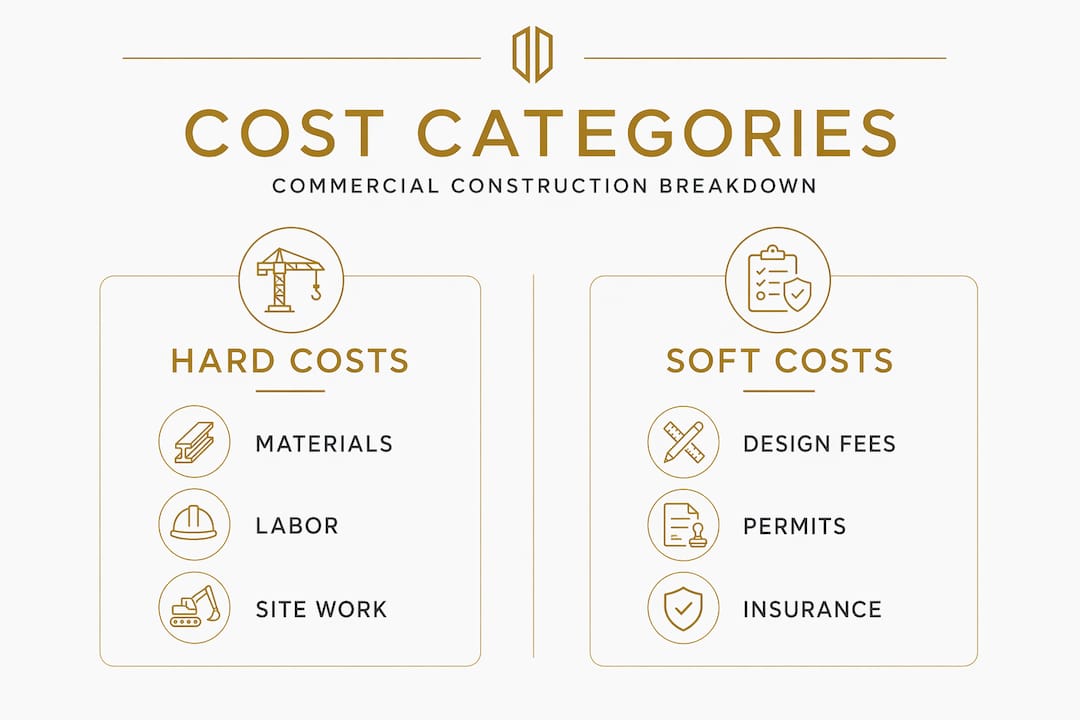
Soft costs cover everything else: architectural and engineering fees, permit fees, environmental studies, legal costs, financing costs, insurance, and project management. Soft costs are where budgets quietly fall apart, because they are harder to estimate early and easier to underestimate.
Key cost drivers to track from day one:
- Labor rates. Construction wages average $38.73 per hour as of 2026, roughly 20% above the broader private sector average. A tight labor market means skilled trades carry premium pricing, and scheduling delays compound that cost.
- Scope definition. Vague project scope is the single most common driver of change orders, which can alter total budgets by 20% or more. Locking down scope before breaking ground is not optional.
- Site conditions. Soil conditions, utility connections, and access constraints can add significant cost that no preliminary budget anticipates.
- Specialty systems. Healthcare, laboratory, and data center projects carry MEP costs that dwarf standard office construction.
Pro Tip: Build a contingency line into your budget from the start. A 10% contingency on hard costs and 15% on soft costs is not pessimism. It is the difference between a project that finishes on budget and one that requires emergency financing mid-construction.
The labor market constraint deserves particular attention right now. Strategic supply-chain and workforce planning have become prerequisites for protecting project margins, not afterthoughts. Owners who lock in subcontractor commitments early in the preconstruction phase consistently outperform those who wait.
Regulatory and code requirements
Commercial construction operates under a substantially more demanding regulatory framework than residential work. Understanding that framework protects your timeline and your investment.
The International Building Code (IBC) has been adopted by 49 states and governs virtually all commercial construction in the US. Its requirements are more stringent than the International Residential Code in almost every category, covering fire resistance, structural loads, accessibility under the Americans with Disabilities Act (ADA), energy performance, and means of egress.
Buildings are classified by occupancy group, and that classification drives the specific code requirements that apply. Common occupancy groups include:
- Business (B): Offices, professional services, outpatient clinics
- Assembly (A): Restaurants, theaters, houses of worship
- Educational (E): Schools and daycare facilities
- Institutional (I): Hospitals, detention facilities, nursing homes
- Mercantile (M): Retail stores and markets
Each occupancy group carries different requirements for fire-resistance ratings, sprinkler systems, exit configurations, and allowable building heights and areas. A building housing multiple uses (say, ground-floor retail with office above) must address the requirements of each occupancy group present.
Permit applications for commercial projects typically require sealed construction documents, site plans, energy compliance calculations, and structural engineering reports. Inspections occur at multiple stages: foundation, framing, rough MEP, insulation, and final. The process concludes with a certificate of occupancy, which is the legal authorization to use the building for its intended purpose.
Compliance is not just a legal obligation. It is a practical one. A building that cannot obtain its certificate of occupancy cannot be occupied, leased, or financed against. Every day of delay after construction completion costs money.
My perspective on navigating commercial projects
I have watched first-time commercial investors make the same mistakes repeatedly, and most of them trace back to treating commercial construction like a larger version of residential work. It is not. The risk profile is different, the documentation burden is different, and the consequences of poor planning are far more severe.
The single most underrated move in commercial construction is investing in a thorough preconstruction phase. Owners who rush to break ground to “save time” almost always spend more time and money correcting problems that a proper pre-construction review would have caught. I have seen projects where early GC engagement reduced cost variance from roughly 12% down to 2%. That is not a marginal improvement. That is the difference between a project that pencils and one that does not.
Contract review deserves equal attention. Risk allocation clauses, change order thresholds, and liquidated damages provisions look like boilerplate until something goes wrong. Then they determine who pays for the problem. Get a construction attorney involved before you sign, not after the dispute starts.
Finally, plan your closeout before you start construction. I know that sounds counterintuitive, but commissioning and punch list activities that are not scheduled into the project timeline will compress at the end and create exactly the kind of occupancy delays that erode your return. The owners who finish on time are the ones who treated closeout as a phase, not an afterthought.
— Daniel
How Builtblackbriar approaches complex builds

Builtblackbriar brings the same discipline that governs the best commercial projects to every high-end build in Los Angeles. The firm’s transparent process keeps clients informed at every phase, from schematic design through final commissioning, with technology-driven communication that eliminates the guesswork that typically plagues complex projects. Builtblackbriar’s construction services cover the full spectrum of coordination, documentation, and project management that demanding builds require. Whether you are developing a property in East Los Angeles or pursuing a luxury build in West Hollywood, Builtblackbriar’s specialization in technically complex work, including subterranean basements and large-scale glass installations, means your project is managed with the rigor it deserves. Reach out to explore what a disciplined, on-budget build looks like in practice.
FAQ
What is commercial construction?
Commercial construction refers to the design and building of structures intended for business, institutional, or public use, including offices, retail centers, healthcare facilities, warehouses, and mixed-use developments. It differs from residential construction in its regulatory framework, project complexity, and procurement methods.
How does commercial construction differ from residential?
Commercial projects follow the International Building Code (IBC), require occupancy classification, and involve more complex permitting, inspection, and coordination requirements than residential builds governed by the International Residential Code (IRC).
What are the main phases of the commercial construction process?
A commercial project typically moves through pre-construction planning, design development and permitting, contractor procurement, active construction, and closeout with commissioning. Each phase builds on the last, and gaps between them create cost and schedule risk.
How much does commercial construction cost?
Costs vary widely by project type, location, and complexity. Hard costs (materials and labor) represent roughly 70-80% of the total budget, with soft costs covering design fees, permits, and management making up the remainder. Labor wages averaging $38.73 per hour in 2026 are a significant cost driver.
Why does early contractor involvement matter?
Bringing a general contractor into the project during schematic design allows for constructability reviews and value engineering that can reduce the project schedule by 15-25% and keep cost variance well below the industry average.