

May 26, 2026
What Is Construction Project Management? A Clear Guide

Construction project management is one of the most misunderstood disciplines in the built environment. Most people picture a hard hat and a clipboard, maybe someone shouting across a jobsite about concrete pours. The reality is far more structured. What is construction project management, properly defined? It is a structured, integrated process that governs every dimension of a build, from initial feasibility through final closeout, while simultaneously managing scope, time, cost, quality, safety, and the communication web that connects dozens of stakeholders. Get it right, and projects finish on time and on budget. Get it wrong, and the consequences ripple across every party involved.
Table of Contents
- Key takeaways
- What construction project management really means
- The six phases of a construction project
- Roles and responsibilities on a construction team
- Core management functions and the tools behind them
- Best practices that separate good projects from great ones
- My perspective on what actually separates great construction management from average
- How Builtblackbriar puts these principles into practice
- FAQ
Key takeaways
| Point | Details |
|---|---|
| More than scheduling | Construction project management governs scope, cost, quality, safety, and communication, not just timelines. |
| Six lifecycle phases | Projects move through initiation, planning, procurement, execution, monitoring, and closeout in sequence. |
| Monitoring runs concurrently | Tracking progress during execution, not after, is what prevents costly overruns. |
| Roles vary by delivery method | Whether the manager represents the owner or leads as a general contractor changes their authority and obligations. |
| Triple constraints always apply | Every decision involving time, cost, or quality creates a trade-off the project team must manage consciously. |
What construction project management really means
The formal industry term for this discipline is construction management (CM), and it goes considerably deeper than its casual description suggests. Construction management encompasses scope, cost, time, quality, contract administration, safety, and professional practice management, all functioning together within a single project framework.
At its center sits what practitioners call the project management triangle: three interdependent constraints of time, cost, and quality. Accelerating a schedule often increases costs; cutting costs frequently affects quality; pushing quality standards without adjusting time or budget creates friction that can derail a build. Skilled project managers do not eliminate these trade-offs. They negotiate them consciously, with full awareness of each decision’s downstream effects.
Construction management basics also include a coordination responsibility that most people underestimate. A typical mid-size residential project involves the owner, general contractor, multiple subcontractors, material suppliers, municipal inspectors, and sometimes a lender with their own reporting requirements. Coordination among owners, contractors, and regulators is not a soft skill. It is a formal function woven into every phase of project delivery.
Pro Tip: When evaluating a construction manager for your project, ask specifically how they handle scope changes during execution. Their answer will tell you more about their actual competence than any credentials on paper.
Construction management also requires fluency in contract structures, building codes, permit processes, and procurement law. A project manager who understands only scheduling is, in practice, managing only a fraction of the job.
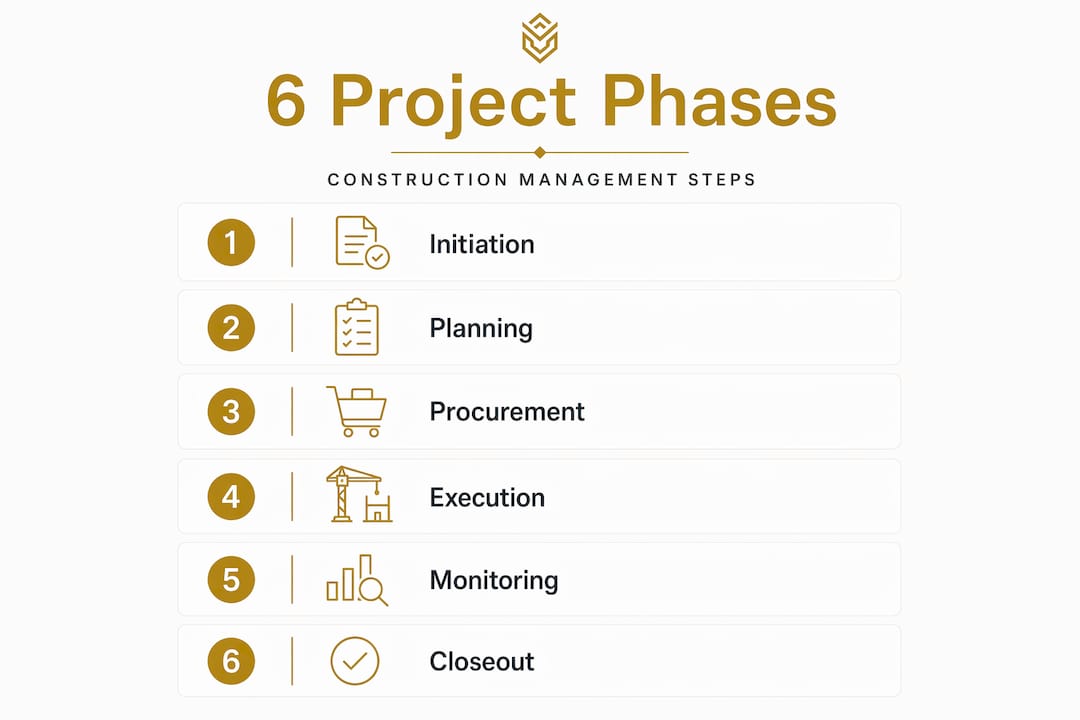
The six phases of a construction project
Understanding construction project phases gives you a precise mental map of where decisions get made, where risks concentrate, and where the most expensive mistakes tend to occur.
-
Initiation. This is where the project is defined at a high level. The owner establishes goals, feasibility studies are conducted, and the project’s fundamental scope and budget parameters take shape. Skipping rigorous initiation is the single most common cause of scope creep later.
-
Planning. Detailed planning covers everything: design development, scheduling, cost estimating, procurement strategy, permit acquisition, and risk assessment. Construction project planning at this phase is where the entire project baseline gets set. Changes made here cost a fraction of what they cost during execution.
-
Procurement. Contracts are finalized, subcontractors are selected, materials are sourced, and long-lead items (such as custom glass assemblies or specialized structural elements) are ordered. Procurement decisions made without attention to lead times have a habit of stalling even well-planned schedules.
-
Execution. Physical construction begins. This is the phase most visible to clients and observers, and also the phase where the work of every preceding phase gets tested. A well-planned project runs more quietly here because problems were resolved on paper, not in the field.
-
Monitoring and controlling. Critically, monitoring runs in parallel with execution, not after it. Progress is measured against the baseline plan, budgets are tracked in real time, and deviations trigger corrective action immediately rather than at month-end reporting.
-
Closeout. The project is commissioned, inspections are completed, punch lists are resolved, and documentation is assembled and handed off. A thorough closeout protects owners from warranty disputes and ensures contractors meet their contractual obligations in full.
Pro Tip: The monitoring phase is where most projects quietly begin to fail. If your project manager is presenting updates monthly rather than weekly, ask why. Weekly tracking during execution is the standard in high-performance construction teams.
Each phase builds directly on the previous one. A weak planning phase makes execution chaotic. Inadequate procurement causes execution delays. Skipping formal closeout leaves owners exposed. The sequence is not arbitrary.
Roles and responsibilities on a construction team
The roles in project management within a construction context are more nuanced than most clients realize before they begin a project.
The construction project manager (CPM) is the central figure. Their responsibilities include:
- Setting and maintaining the project baseline (scope, schedule, budget)
- Managing contracts with the general contractor and specialty subcontractors
- Coordinating design consultants and engineers
- Reporting to the owner on project status, risks, and decisions required
- Administering changes and managing their impact on cost and schedule
One distinction worth understanding is the difference between a construction manager and a general contractor (GC). A GC holds the prime contract, assumes liability for construction delivery, and typically self-performs some of the work. A construction manager, particularly one acting as an owner’s representative, has an advisory and oversight role without necessarily holding subcontracts. Delivery method impacts governance: a construction manager in an agency role has a different risk profile and authority than one acting as a GC.
Site supervisors and superintendents translate the project plan into daily field operations. They manage subcontractor sequencing on site, enforce safety protocols, and report field conditions back to the project manager. Subcontractors, meanwhile, are specialized trades (electrical, mechanical, structural steel, glazing) who execute specific scopes under contract.
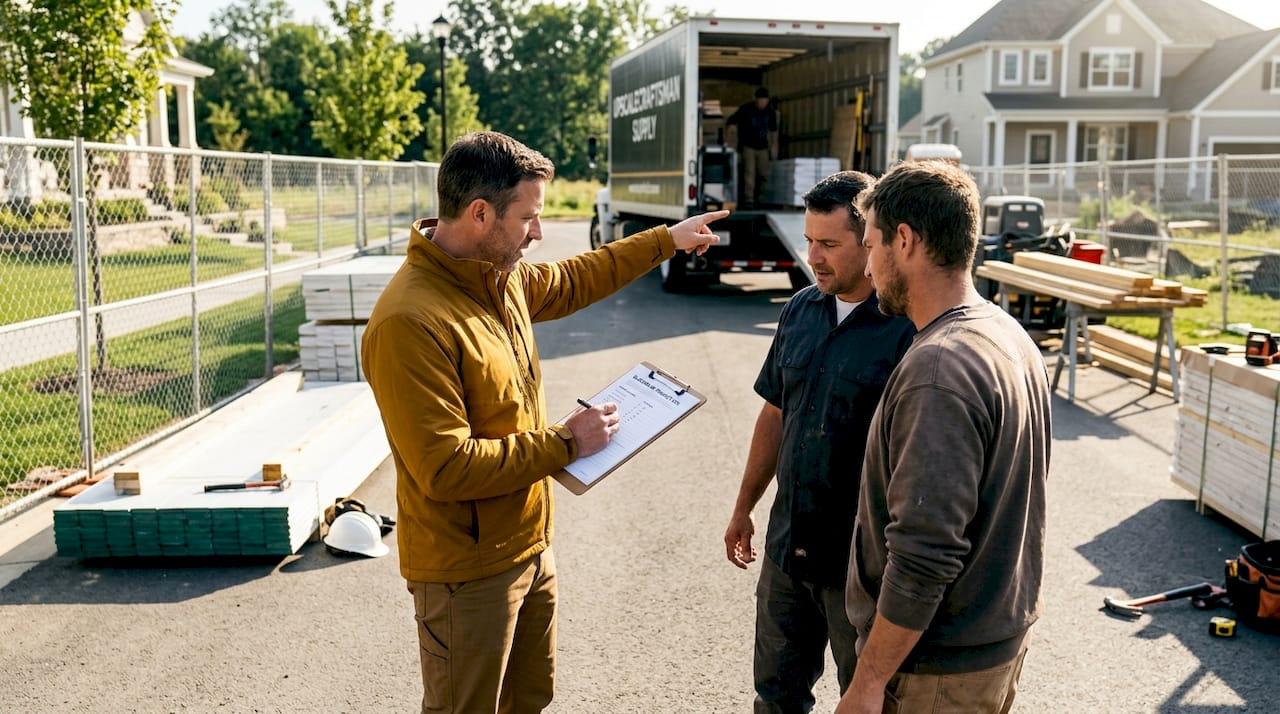
Effective communication among all these parties is not optional. On complex builds with tight site logistics, a miscommunication between a structural subcontractor and a glazing crew can result in days of rework and significant cost exposure.
Core management functions and the tools behind them
What does a construction manager do, functionally, on any given day? The work organizes itself into five core management areas, each with its own tools and disciplines.
| Management function | Core activity | Common tool or technique |
|---|---|---|
| Scope management | Define deliverables and control change | Change order logs, scope matrix |
| Time management | Build and track the project schedule | Critical path method (CPM), Gantt charts |
| Cost management | Estimate, budget, and monitor spending | Cost codes, earned value analysis |
| Quality management | Verify workmanship meets specs and standards | Inspection checklists, submittal reviews |
| Risk management | Identify and mitigate potential issues proactively | Risk registers, contingency planning |
Scope management deserves particular attention because scope creep is the single most common reason projects exceed their budgets. Every change to the project, however small it seems, must pass through a formal change control process that evaluates its impact on time, cost, and quality before approval. A custom home budget planning checklist can illustrate just how granular cost and scope tracking needs to be from the earliest phases.
Risk management, meanwhile, is often treated as a formality until something goes wrong. A well-maintained risk register that is reviewed weekly during execution, not filed away after the planning phase, is what separates proactive teams from reactive ones. The importance of project management in construction is nowhere more visible than in how a team handles a risk that was identified and mitigated before it became a crisis.
Best practices that separate good projects from great ones
The difference between a project that finishes on time and budget and one that does not often comes down to discipline in a handful of repeating behaviors, not any single decision.
- Treat monitoring as a continuous function. Ignoring concurrent monitoring during execution leads to delayed issue detection and expensive corrective action. The best project managers build weekly plan-versus-actual reviews into the project rhythm from day one.
- Document every change formally. Verbal agreements about scope adjustments are among the most expensive habits in construction. Every change request, however small, should be documented, priced, and approved in writing before work proceeds.
- Invest in stakeholder alignment early. The cost of resolving a misalignment between the owner’s vision and the design team’s interpretation drops dramatically when it is caught in planning rather than during framing.
- Integrate field operations with formal project controls. Field management and baseline controls must communicate with each other daily. A project manager who is rarely on site and a site superintendent who never reads the schedule report are working on different projects.
Contractor experience also factors directly into outcomes. Teams with deep experience in a project type carry institutional knowledge about where risks concentrate and how to sequence work efficiently, knowledge that no checklist fully replaces.
Pro Tip: Build a communication protocol at project kickoff that specifies who gets what information, in what format, and on what cadence. Projects that define this on day one spend far less time later managing confusion.
My perspective on what actually separates great construction management from average
I’ve spent years watching projects succeed and watching them quietly unravel, and the single most consistent differentiator is not technology, contract structure, or budget size. It is how seriously a team treats concurrent monitoring during execution.
Most teams plan well. The schedule gets built, the risk register gets populated, the kickoff meeting goes smoothly. Then execution begins, and the monitoring function slowly becomes a reporting function rather than a management function. By the time the numbers are compiled into a monthly report, the opportunity to course-correct has often already passed.
What I’ve learned is that the best construction managers treat the baseline plan not as a document to report against, but as a living instrument they are actively steering. They are on site, they are comparing actuals to forecast weekly, and they are making small adjustments before small deviations become structural problems.
I’ve also observed that how roles are defined at the start of a project shapes everything that follows. When a construction manager’s authority and accountability are clearly scoped, whether acting as an owner’s representative or leading as a GC, decisions move faster, conflicts resolve more cleanly, and the owner always knows exactly who to call. Ambiguity in roles is a project risk, and it belongs in the risk register on day one.
— Daniel
How Builtblackbriar puts these principles into practice
Builtblackbriar brings construction project management principles to life for discerning clients across Los Angeles, including projects of genuine technical complexity.

Whether you are building a subterranean basement that requires precise structural sequencing or specifying oversized glass systems that demand precise procurement timing, Builtblackbriar’s process keeps every phase documented, every stakeholder aligned, and every milestone tracked against a committed schedule. Clients receive regular progress updates and remain actively involved in each decision point throughout the build. The result is not just a finished home. It is a project delivered with the kind of schedule adherence and budget discipline that high-end residential construction demands. Explore luxury home building in Los Angeles or learn how Builtblackbriar delivers across Westlake projects with the same rigor.
FAQ
What is construction project management in simple terms?
Construction project management is the process of planning, coordinating, and controlling every aspect of a construction project, including scope, budget, schedule, quality, and safety, from start to final handover.
What are the main phases of a construction project?
Most construction projects move through six phases: initiation, planning, procurement, execution, monitoring and controlling, and closeout. Monitoring runs concurrently with execution rather than after it.
What does a construction manager do differently from a general contractor?
A construction manager typically represents the owner’s interests by overseeing planning, coordination, and contract administration, while a general contractor holds the prime contract and is directly responsible for delivering the physical construction work.
Why does construction project management matter for cost control?
Without formal cost management, scope management, and change control processes in place, small deviations in scope or schedule compound quickly into significant budget overruns. Proactive monitoring during execution is what keeps cost exposure manageable.
What is the project management triangle in construction?
The project management triangle refers to the interdependent constraints of time, cost, and quality. Adjusting any one of them affects the others, and construction managers must negotiate these trade-offs consciously throughout every phase of the project.