

June 9, 2026
What Makes a Contractor Reliable: A 2026 Guide

A reliable contractor is defined by verifiable credentials, transparent communication, consistent workmanship, and fair payment practices that protect you from the first conversation to the final walkthrough. For homeowners and property developers, knowing what makes a contractor reliable before signing anything is the single most effective way to protect your investment. The construction industry in Los Angeles and across California operates under specific licensing laws, insurance mandates, and deposit caps that separate legitimate professionals from risky hires. This guide covers every trait and verification step you need, drawing on expert hiring guidance and 2026 industry standards.
What makes a contractor reliable: credentials and insurance
The foundation of contractor reliability is legal standing. A contractor without a valid state license and adequate insurance is not just a business risk. They are a legal liability that can fall entirely on you.
General contractor licenses vary by scope. In California, the Contractors State License Board (CSLB) issues licenses by classification, meaning a Class B general building contractor handles structural work while specialty trades like electrical (Class C-10) or plumbing (Class C-36) require separate credentials. Verifying a contractor’s license through the CSLB website takes under two minutes and confirms active status, bond information, and any disciplinary history.
Insurance is equally non-negotiable. Reliable contractors carry general liability insurance with a minimum of $1 million in coverage, plus workers’ compensation for every employee on site. That $1 million floor matters because a single on-site injury or structural mistake can generate claims well above that threshold. Do not accept a certificate of insurance at face value. Call the insurer directly to confirm the policy is active and that you are listed as an additional insured for the project duration.
Unlicensed contractors often charge less upfront, but the exposure is severe. If an unlicensed worker is injured on your property, you may be held personally liable for medical costs and lost wages. The Better Business Bureau and state licensing boards both maintain public complaint records that reveal patterns of negligence or fraud before you ever meet a contractor in person.
Pro Tip: Ask for the contractor’s license number before the first meeting and verify it independently through your state licensing board. Any hesitation to provide it is a disqualifying signal.
How do you evaluate a contractor’s communication quality?
Communication quality during the sales phase is the strongest predictor of how a contractor will manage your project once work begins. A contractor who responds slowly, sends vague proposals, or avoids direct questions during bidding will behave the same way when problems arise mid-construction.
Here is a structured approach to evaluating communication before you commit:
- Response time. A professional contractor responds to initial inquiries within 24 hours. Delays at the bidding stage signal disorganization or overextension.
- Proposal specificity. Generic bids that list “labor and materials” without line-item detail are a warning sign. Reliable contractors provide itemized proposals that reflect a genuine understanding of your project scope.
- Clarifying questions. A contractor who asks thoughtful questions about your goals, site conditions, and timeline demonstrates engagement. One who simply quotes a number without asking anything has not actually assessed your project.
- Handling of negative feedback. Contractors who acknowledge complaints and resolve them constructively demonstrate accountability. Those who ignore or dismiss negative reviews are showing you exactly how they handle problems on your job site.
- Dispute resolution process. Ask directly: “How do you handle disagreements about scope or timeline?” A confident, specific answer indicates experience. Vague deflection indicates avoidance.
Poor communication accounts for 90% of construction disputes, which means the vetting conversation itself is your most reliable data point. Treat it as a performance review, not just a price comparison.
Pro Tip: Commission a small paid test project, such as a site assessment or detailed scope document, before awarding a major contract. This reveals the contractor’s workflow, attention to detail, and responsiveness under real conditions.

What should you look for in a contractor’s track record?
A contractor’s history is the clearest window into their future performance. Past behavior on projects of similar scale and complexity tells you more than any sales pitch.
Contractors with at least 3 to 5 years of continuous operation under the same business entity are significantly lower risk than newer entrants or those who frequently restructure under new company names. Business longevity signals the ability to manage projects, retain skilled crews, resolve conflicts, and maintain financial stability through market cycles. A contractor who has survived multiple years in a competitive market like Los Angeles has demonstrated something real.
When checking references, ask these specific questions:
- Was the project completed on time and within the original budget?
- How were unexpected problems handled, and were you informed promptly?
- Would you hire this contractor again for a project of similar scope?
- Was the job site kept clean and organized throughout construction?
- Did the final result match what was described in the contract?
Visiting active or completed job sites provides evidence that no reference call can replicate. You observe crew professionalism, material quality, site organization, and construction precision firsthand. Ask the contractor to arrange a site visit. Reluctance to do so is itself informative.
Trade association memberships, such as the National Association of Home Builders (NAHB) or the Associated General Contractors of America (AGC), add another layer of credibility. These organizations require members to meet professional standards and provide recourse for disputes.
| Reliability indicator | What to verify |
|---|---|
| Business longevity | Minimum 3 to 5 years under the same entity name |
| Reference quality | On-time, on-budget delivery confirmed by past clients |
| Site visit observation | Clean site, organized crew, visible quality of work |
| Association membership | NAHB, AGC, or state-level trade body affiliation |
| Complaint history | No unresolved BBB complaints or licensing board actions |
How do contract terms reveal a contractor’s reliability?
A contractor’s willingness to provide a detailed, fair contract is one of the clearest signs of a dependable contractor. Vague agreements protect the contractor, not you.
Well-structured contracts cover six non-negotiable elements: a detailed scope of work, a milestone-based payment schedule, a change order process, permit responsibilities, warranty terms, and a timeline with defined completion benchmarks. Each element closes a specific loophole that unreliable contractors exploit. A change order clause, for example, prevents a contractor from adding costs mid-project without your written approval.
Payment structure is where many homeowners get hurt. Reputable contractors structure payments around project milestones rather than large upfront sums. Industry best practice caps initial deposits at 10 to 15% of the total contract value. California law is even stricter, capping deposits at $1,000 or 10% of the contract price, whichever is less. Any contractor demanding 30%, 50%, or full payment upfront is operating outside both ethical norms and legal boundaries in many states.
| Payment approach | Risk level |
|---|---|
| Milestone-based schedule (10 to 15% deposit) | Low. Payments tied to verified progress protect both parties. |
| Large upfront deposit (30% or more) | High. Funds contractor operations with no performance guarantee. |
| Cash-only payment requests | Very high. Eliminates paper trail and legal recourse. |
| Full payment before project start | Extreme. No leverage remains if work is substandard or abandoned. |
Milestone-based payment schedules also incentivize the contractor to maintain momentum. When payment is tied to completed phases, such as foundation, framing, and rough-in inspections, the contractor’s financial interest aligns with your project timeline.
Pro Tip: Never pay the final installment until you have conducted a thorough walkthrough, confirmed all punch-list items are resolved, and received copies of all permits, warranties, and inspection sign-offs.
Common warning signs of an unreliable contractor
Recognizing the signs of an unreliable home contractor before you sign protects you from costly mistakes that can take months and significant legal effort to resolve.
Watch for these specific red flags:
- Excessive upfront deposits. Any request beyond 10 to 15% of the contract value, or above California’s $1,000 legal cap, is a disqualifying condition.
- Refusal to provide credentials. A contractor who cannot immediately produce a license number, insurance certificate, and business address is not operating legitimately.
- Asking you to pull permits. Contractors who shift permit responsibility to homeowners are almost certainly avoiding licensing scrutiny and transferring legal liability to you.
- Abnormally low bids. A bid significantly below two or three competing estimates signals either missing scope, substandard materials, or a contractor who plans to recover margin through change orders.
- No physical business address. Contractors operating solely through a mobile number and a generic email address have no accountability infrastructure.
- Unresolved complaints. Multiple unresolved complaints on the Better Business Bureau, Google, or Yelp, particularly those describing abandoned projects or withheld deposits, are patterns, not outliers.
- Pressure tactics. “This price is only good today” is a sales technique, not a professional practice. Reliable contractors give you time to review proposals and references.
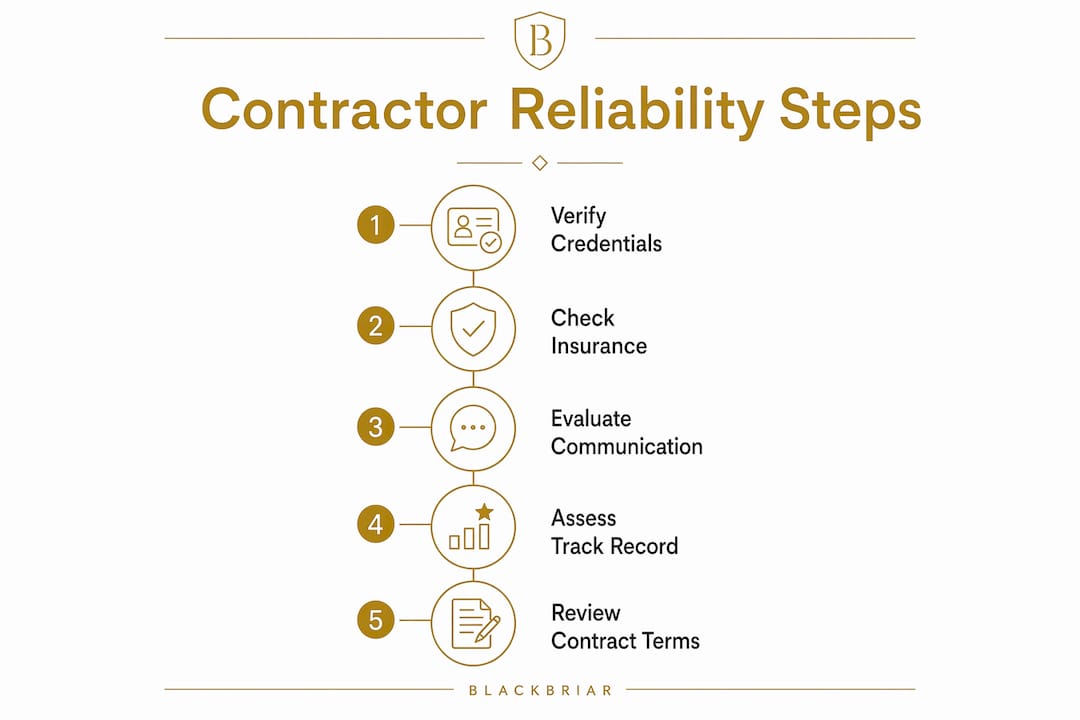
Licensing verification, insurance confirmation, and direct reference checks together form the most effective defense against contractor fraud. Skipping any one of these steps is where most homeowners encounter problems. Building a simple due diligence checklist and working through it systematically before any contract is signed takes less than a week and can save you tens of thousands of dollars.
Key takeaways
A reliable contractor combines verified credentials, proactive communication, a documented track record, and transparent contract terms that protect your investment at every phase.
| Point | Details |
|---|---|
| Verify credentials independently | Confirm license status and insurance directly with the CSLB and the insurer, not just from documents provided. |
| Treat communication as a performance test | Response speed and proposal quality during bidding predict project management behavior during construction. |
| Prioritize business longevity | Contractors with 3 to 5 or more years under the same entity carry significantly lower risk than newer or frequently restructured operations. |
| Insist on milestone-based payments | Deposits above 10 to 15% of contract value are a red flag; California caps them at $1,000 or 10%, whichever is less. |
| Use contracts as your primary protection | A detailed contract covering scope, change orders, permits, and warranty terms reduces the majority of post-hire disputes. |
What I have learned vetting contractors on complex builds
Working on high-end residential projects in Los Angeles, I have seen the same pattern repeat: the homeowners who had the smoothest builds were the ones who treated the vetting process as seriously as the design process itself. They asked hard questions early, visited job sites, and insisted on detailed contracts before any money changed hands.
The most expensive lesson I have witnessed came from a client who skipped reference checks because the contractor’s portfolio looked impressive online. The project ran four months over schedule, and the change order disputes consumed more in legal fees than the original overrun. The portfolio was real. The communication and contract discipline were not.
What I tell every client now is this: a contractor’s behavior during the proposal phase is a dress rehearsal for the entire project. If they are slow to respond, vague about costs, or resistant to providing references, those traits do not improve once they have your deposit. They get worse.
The good news is that reliable contractors exist in abundance, and they are not hard to identify once you know what to look for. Invest two to three weeks in structured vetting, visit at least one active job site, and read every line of the contract before signing. That time investment pays for itself many times over in a project that finishes on schedule, within budget, and without regret.
For properties in California Heights and surrounding communities, the same principles apply regardless of project scale. The fundamentals of contractor reliability do not change with the size of the build.
— Daniel
Why Builtblackbriar sets the standard for reliable luxury construction

Builtblackbriar brings every quality of a trustworthy contractor to the most demanding residential projects in Los Angeles. Every build begins with a fully licensed and insured team, milestone-based payment schedules, and a detailed contract that defines scope, change order procedures, and warranty terms before a single permit is pulled. Clients receive real-time project updates through an integrated communication platform, keeping them involved at every phase without the guesswork. Whether you are planning a subterranean basement, an oversized glass installation, or a ground-up custom home, Builtblackbriar’s track record of on-time, on-budget completions speaks for itself. Explore what a genuinely reliable build looks like with Westlake luxury home builders or review the full range of services available through Los Angeles luxury home building.
FAQ
What licenses should a reliable contractor hold?
A reliable general contractor holds a valid state-issued license appropriate to the scope of work, such as a Class B license in California for structural projects. Specialty trades like electrical and plumbing require separate classifications, all verifiable through the Contractors State License Board.
How much deposit is reasonable for a home contractor?
Industry best practice limits upfront deposits to 10 to 15% of the total contract value. California law caps deposits at $1,000 or 10% of the contract price, whichever is less, making any larger demand a legal violation in that state.
What are the top signs of a dependable contractor?
The strongest signs of a dependable contractor include a verified license, active insurance with at least $1 million in general liability coverage, a milestone-based payment schedule, detailed written contracts, and positive references from clients on comparable projects.
Why is communication a key trait of reliable contractors?
Communication speed and clarity during the bidding phase directly predict how a contractor manages problems during construction. Contractors who respond promptly and provide specific proposals demonstrate the organizational discipline that complex projects require.
Should a contractor pull permits, or should the homeowner?
The contractor should always pull permits. A contractor who asks the homeowner to pull permits is likely avoiding licensing requirements and transferring legal liability. This practice is a recognized red flag across the construction industry.