

June 12, 2026
Why Commercial Builds Need Specialized Contractors

Commercial construction is defined by a level of technical complexity, regulatory scrutiny, and financial exposure that makes specialized contractors not optional but structurally required. Understanding why commercial builds require specialized contractors starts with recognizing that general contractors coordinate projects but cannot personally execute the precision work that commercial codes, ADA standards, and OSHA regulations demand. A single misstep in electrical systems, fire suppression, or structural concrete can trigger cascading delays, legal liability, and cost overruns that dwarf the savings from cutting corners on expertise. The projects that finish on time and on budget are the ones built on a foundation of vetted specialty trades from day one.
Why commercial builds require specialized contractors
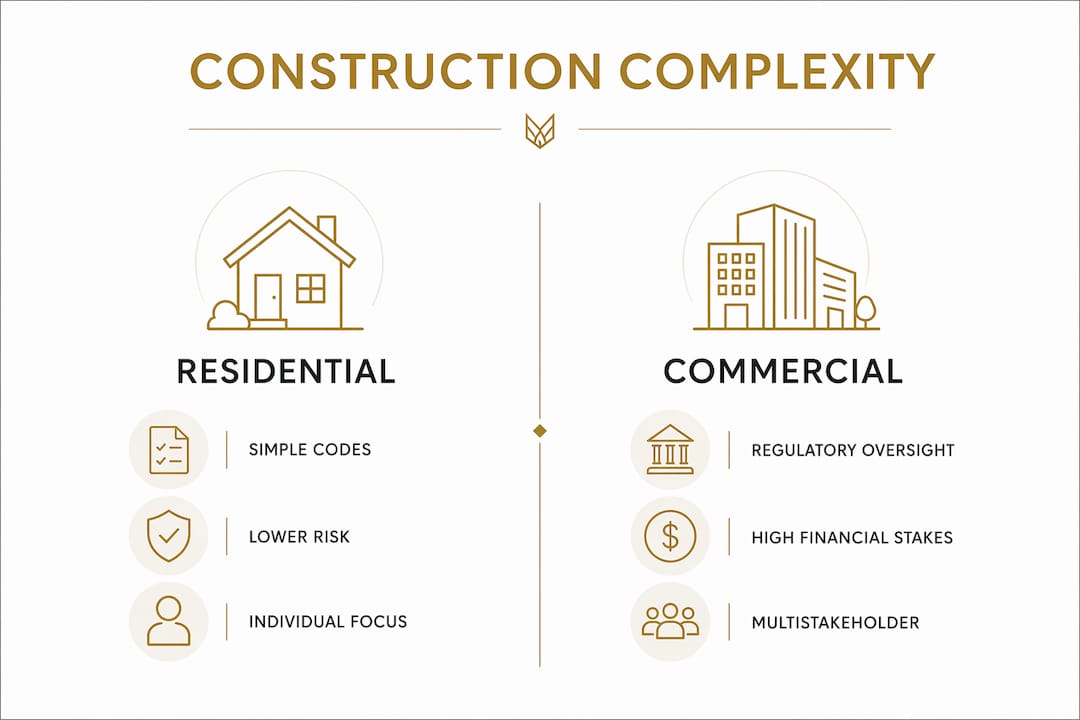
Commercial construction and residential construction share a vocabulary but not a reality. Commercial projects require compliance with commercial-specific building codes, ADA standards, and phased certifications, with timelines stretching from 3 to 24 or more months. That timeline reflects the number of parties involved: architects, structural engineers, lenders, municipal inspectors, and specialized consultants all hold approval authority at different phases.
The financial stakes compound the complexity. A residential project gone wrong affects one family. A commercial build gone wrong affects investors, tenants, employees, and the public. Structures designed for thousands of daily occupants require absolute precision in foundational engineering, fire egress, and load calculations. General contractors function as conductors, managing risk and logistics, but they depend on specialty trades to perform the critical technical work that compliance demands.
Commercial builds also carry a document-heavy accountability framework. Schedules of values, submittal logs, shop drawing approvals, and occupancy certification timelines replace the informal update cadence common in residential work. Project managers who underestimate this shift often find themselves managing paperwork crises before a single wall goes up.
What makes commercial construction more complex than residential?
The gap between residential and commercial construction is not just scale. It is a difference in kind.
| Factor | Residential | Commercial |
|---|---|---|
| Regulatory oversight | Local building codes | ADA, OSHA, fire codes, occupancy certs |
| Stakeholder count | Owner, contractor, inspector | Architects, engineers, lenders, consultants |
| Timeline | 6–18 months typical | 12–36+ months with phased approvals |
| Financial risk | Hundreds of thousands | Millions to hundreds of millions |
| Documentation | Basic permits and plans | Schedules of values, submittals, shop drawings |
A commercial office building in Los Angeles, for example, requires seismic engineering reviews, Title 24 energy compliance, and fire department sign-off before occupancy. Each approval gate can stall the project if the wrong contractor submitted incomplete or noncompliant documentation. Administrative lag from scattered approval processes can stall timelines before foundation work even begins. Centralized project management systems are not a luxury in commercial builds. They are a survival tool.
The multi-stakeholder environment also means that a single specialty contractor’s delay ripples across every other trade. When the mechanical contractor falls behind, the electrical rough-in cannot proceed. When the electrical rough-in stalls, drywall cannot close. The sequencing dependency in commercial builds is tighter and less forgiving than anything in residential construction.
Which specialty contractors are critical in commercial builds?
The roster of specialty trades in a commercial project reads like a technical organization chart. Each discipline carries its own licensing requirements, equipment demands, and code compliance obligations.
- Structural concrete contractors handle post-tensioned slabs, shear walls, and foundation systems that must meet engineer-stamped specifications. Errors here are not correctable without demolition.
- Mechanical, electrical, and plumbing (MEP) contractors coordinate the building’s operational systems. In healthcare facilities, specialized ventilation and infection control systems require contractors who understand ASHRAE standards and emergency access codes, not just standard HVAC installation.
- Fire protection contractors design and install suppression systems that must pass fire marshal inspection and integrate with the building’s alarm and egress systems.
- Roofing contractors on commercial projects work with TPO membranes, built-up roofing, and green roof assemblies that require manufacturer certifications to maintain warranties.
- Low-voltage and technology contractors handle structured cabling, security systems, and building automation that modern commercial tenants expect as baseline infrastructure.
Specialty contractors bring proprietary tools and equipment that are required to meet strict technical and safety standards. Without that equipment on hand, projects face costly last-minute rentals or, worse, work that fails inspection. The focused skills of specialty contractors also produce measurably higher quality workmanship, reduced rework, and improved safety records compared to generalist labor attempting the same tasks.
Pro Tip: When evaluating a specialty contractor, ask specifically which equipment they own versus rent. Contractors who own their critical tools are less exposed to supply chain delays and more accountable for equipment performance.
What risks arise from using nonspecialized contractors?
The consequences of using nonspecialized contractors in commercial projects are not theoretical. They are documented, expensive, and sometimes irreversible.
“Failing to use specialized contractors can lead to catastrophic outcomes including millions in losses and project delays of several months.” — ruleandmake.com
That outcome is not an edge case. It is the predictable result when a contractor without commercial-grade experience encounters a phased approval process, a complex MEP coordination challenge, or a code compliance audit they were not prepared for. Outdated methods and equipment are a specific risk. A contractor accustomed to residential electrical panels will not have the expertise to design and install a commercial distribution system that meets NEC Article 230 service entrance requirements.
Quality control failures in commercial construction compound quickly. A plumbing rough-in that fails inspection requires opening finished walls, redoing work, and restarting the inspection cycle. Each cycle costs time and money. Choosing a commercial renovation contractor without verifying their commercial-specific experience is one of the most common and costly mistakes project managers make.
Financial risk extends beyond rework costs. Bonding capacity is a more critical metric than portfolio appearance when selecting contractors. A contractor with high-limit bonding capacity protects the owner financially, providing a guarantee of project completion even if the contractor encounters financial distress or abandonment. A contractor without adequate bonding leaves the owner exposed to completion costs that can exceed the original contract value.
Legal penalties add another layer. ADA violations discovered post-occupancy can trigger federal enforcement actions. Fire code deficiencies can result in occupancy permit revocation. These are not recoverable situations without significant legal and construction expense.
How do specialized contractors improve schedule adherence?
Schedule performance in commercial construction is a direct function of how well specialty trades are coordinated and sequenced. Experienced specialty contractors understand the critical path. They know which of their tasks gate other trades and they plan accordingly.
- Early mobilization planning. Specialty contractors with commercial experience arrive with pre-fabricated assemblies, pre-ordered long-lead materials, and pre-approved submittals. They do not start the clock on material procurement after signing a contract.
- Concurrent work execution. Experienced MEP contractors coordinate their rough-in schedules so electrical, plumbing, and mechanical work proceeds in parallel rather than sequentially, compressing the overall schedule.
- Digital integration. Specialty contractors who use platforms like Procore or Autodesk Construction Cloud for submittal tracking and RFI management eliminate the communication gaps that scatter approval processes across email threads and stall foundational work.
- Conflict detection. BIM-coordinated specialty contractors identify clashes between duct runs, pipe chases, and structural members before installation, preventing the field conflicts that generate change orders and delays.
Pro Tip: Require all specialty contractors to submit a three-week lookahead schedule updated weekly. This single practice surfaces sequencing conflicts before they become field crises.
Companies that anticipate specialist capacity needs early avoid project delays and scale more sustainably. Building your specialty contractor network before you need it is not just good planning. It is the difference between a project that runs and one that stalls.
How should project managers hire and integrate specialty contractors?
Vetting specialty contractors for commercial builds requires going well beyond reviewing a portfolio of completed projects. Here is what rigorous evaluation looks like in practice:
- Verify bonding capacity first. Request a letter from the contractor’s surety confirming their single-project and aggregate bonding limits. Match those limits to your project’s contract value before any other evaluation step.
- Audit financial stability. Request two years of financial statements or a Dun and Bradstreet report. A contractor with cash flow problems will prioritize other clients when your project needs them most.
- Confirm equipment ownership. Ask for an equipment inventory list. Contractors who own their critical tools are operationally self-sufficient and less vulnerable to rental market disruptions.
- Evaluate their project management systems. Ask which platforms they use for submittals, RFIs, and daily reports. Contractors still routing approvals through personal email are a scheduling liability.
- Check commercial-specific references. Request references from projects of similar type, scale, and regulatory complexity. A contractor with an excellent residential track record is not automatically qualified for a 200,000-square-foot commercial build.
- Hire early. Building a specialist contractor ecosystem early avoids crisis-driven hiring and gives each trade adequate time to complete submittals, procure materials, and coordinate with adjacent trades before mobilization.
The general contractor’s role in commercial projects is to integrate these specialists into a coherent execution plan. That integration works only when each specialty contractor was selected for operational methodology, not just price or name recognition.
Key takeaways
Commercial builds require specialized contractors because the technical, regulatory, and financial demands of these projects exceed what generalist labor can reliably deliver.
| Point | Details |
|---|---|
| Regulatory complexity demands specialists | ADA, OSHA, and phased occupancy certifications require contractors with commercial-specific compliance experience. |
| Bonding capacity protects owners | Verify surety limits before hiring; bonding capacity is a stronger indicator of contractor reliability than portfolio. |
| Specialty trades reduce rework | Focused expertise in MEP, concrete, and fire protection produces higher quality work and fewer failed inspections. |
| Early hiring prevents delays | Building a vetted specialty contractor network before project start eliminates crisis-driven mobilization and schedule gaps. |
| Digital coordination is non-negotiable | Contractors using platforms like Procore or Autodesk Construction Cloud reduce approval delays and field conflicts. |
What i have learned about specialty contractors the hard way
I have watched project managers make the same mistake repeatedly: they hire a general contractor with an impressive portfolio and assume the specialty trades will sort themselves out. They do not.
The projects I have seen succeed share one characteristic. The owner or project manager treated specialty contractor selection as a primary responsibility, not a delegated afterthought. They verified bonding. They asked about equipment. They required digital submittal systems. They hired early enough that each trade had time to coordinate before mobilization.
The projects that struggled had the opposite pattern. Specialty trades were hired under time pressure, often at the lowest bid, with no verification of commercial experience. The results were predictable: failed inspections, rework, schedule compression, and change orders that eroded the project’s financial case.
My advice to project managers moving from residential to commercial builds is direct. The skills that made you effective in residential construction are necessary but not sufficient. Commercial builds require you to think like a systems integrator. Every specialty contractor you hire is a node in a network, and the network’s performance depends on how well each node was selected and connected.
— Daniel
How Builtblackbriar approaches specialty contractor management
Builtblackbriar brings the same discipline to specialty contractor selection that it applies to every phase of a complex build. Whether the project involves subterranean structural systems, oversized glazing assemblies, or precision MEP coordination, Builtblackbriar’s process starts with rigorous vetting and early integration of the right specialty trades.

Clients working with Builtblackbriar receive transparent reporting, real-time project updates, and the confidence that every contractor on their project was selected for operational capability, not just price. For project managers and owners who want to understand how Builtblackbriar structures its specialized construction services, the full scope of the firm’s approach is available for review. If you are ready to discuss your project, start the conversation with the Builtblackbriar team directly.
FAQ
What is a specialty contractor in commercial construction?
A specialty contractor is a licensed professional focused on a specific trade, such as electrical, plumbing, HVAC, fire protection, or structural concrete, with the certifications and equipment required to meet commercial code standards.
Why can’t a general contractor handle all commercial build tasks?
General contractors manage risk, logistics, and coordination but rely on specialty trades to execute technical work that requires focused expertise, proprietary equipment, and trade-specific licensing.
How does bonding capacity affect contractor selection?
Bonding capacity guarantees project completion even if a contractor faces financial distress, making it a more reliable selection criterion than portfolio appearance alone.
When should specialty contractors be hired in a commercial project?
Specialty contractors should be hired during pre-construction, before mobilization, so they have time to complete submittals, procure long-lead materials, and coordinate with adjacent trades without compressing the schedule.
What happens when nonspecialized contractors work on commercial builds?
Using nonspecialized contractors risks failed inspections, costly rework, compliance violations, and project delays that can result in millions of dollars in losses and months of schedule impact.